Battery Passport India: How BPAN Gives Every Pack an Identity
India's battery passport is the draft Battery Pack Aadhaar System. Its three data layers, how it follows a pack through life and how it compares with the EU's.
By Abhijeet Kumar, ARVOPublished Updated 9 min read
In short
India's battery passport is the Battery Pack Aadhaar System, set out in draft MoRTH guidelines. Each in-scope pack would get a 21-character Battery Pack Aadhaar Number, a QR code with static material and carbon footprint data, and a server record of its status and state of health, updated from production to recycling. It is not yet notified.
- India's battery passport is the Battery Pack Aadhaar Number (BPAN), proposed in draft guidelines that have not yet been formally notified.
- It has three layers: a public 21-character code, static data on a QR code and a lean dynamic record on a government portal.
- A pack gets a new BPAN when it is repurposed or recycled, and its state of health places it in the operational, second-life or end-of-life band.
- The EU battery passport applies from 18 February 2027 and asks for more data, but the draft says BPAN data can be mapped to European schemas.
- A documented battery history helps financiers, used-vehicle buyers and recyclers make decisions from data rather than guesswork.
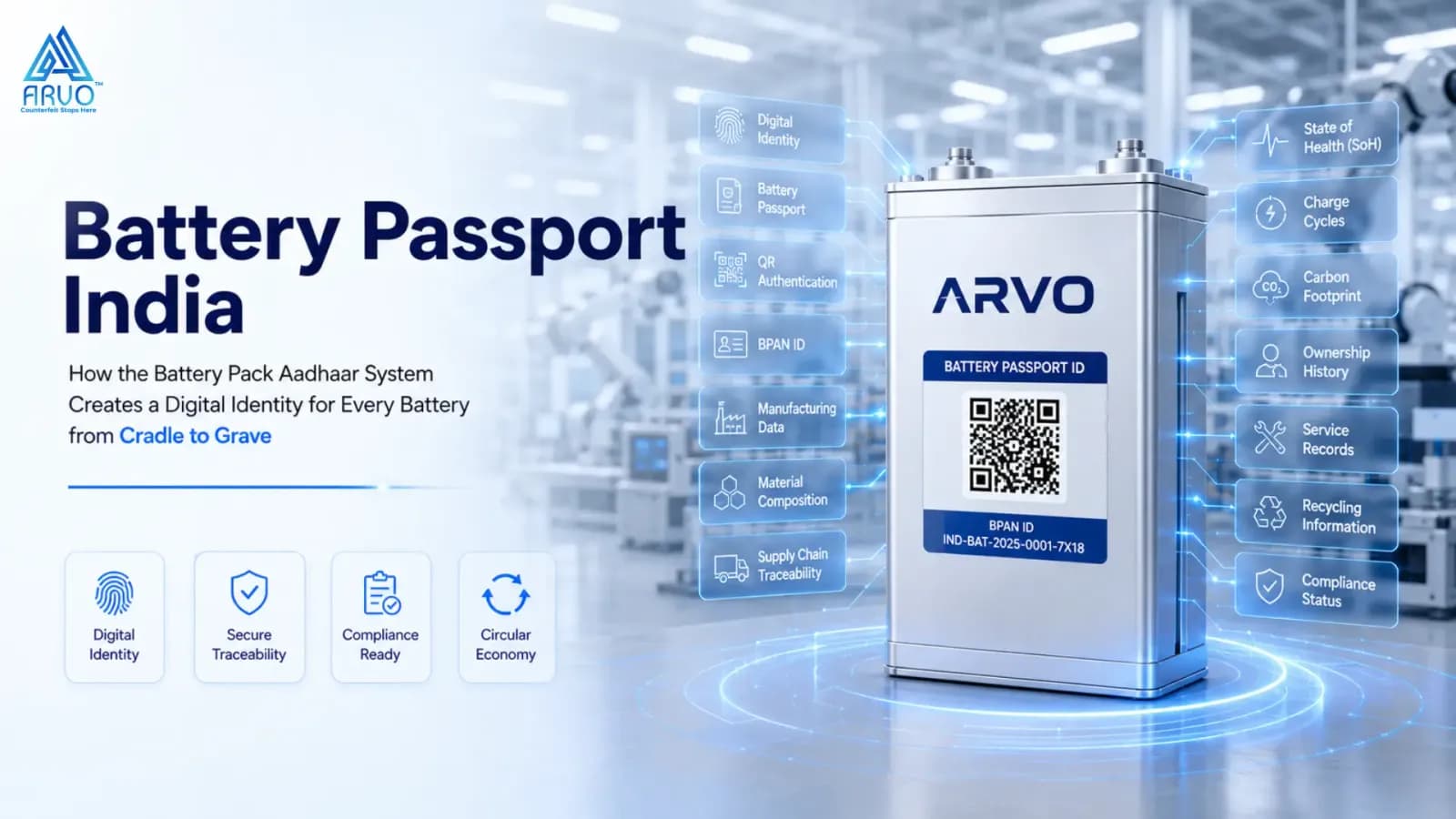
Imagine a battery that could tell you its own history. A lithium-ion pack on a factory floor in Gujarat could say what its cells are made of, where they came from, when it was assembled and which inspection passed it. Years later, powering a delivery vehicle in Pune, the same pack could report how healthy it still is, whether it has ever overheated and where it was last serviced. And at a recycling plant in Chennai, before anyone opens it, a single scan could tell the recycler what is inside and how to take it apart safely.
That is the idea behind a battery passport. In India, it takes the form of the Battery Pack Aadhaar System, set out in draft guidelines that would give every in-scope battery pack a permanent digital identity. This guide explains what India's battery passport contains, how it follows a pack through its life, how it compares with the EU's, and what it changes for the people who make, finance and recycle batteries.
What is India's battery passport?
A battery passport is a digital record tied to one physical battery, built up from production to recycling. India's version is the Battery Pack Aadhaar Number (BPAN): a unique 21-character identity for each pack, marked on the pack as text and as a QR code, with a record on a government BPAN portal.
The guidelines were drafted by a committee that the Ministry of Road Transport and Highways (MoRTH) constituted by an office memorandum of 17 September 2025, and pv magazine India reported their release on 5 January 2026. They are still a draft. The framework has not been formally notified, and the draft recommends taking it forward through the Automotive Industry Standard (AIS) route, with stakeholder consultation and technical validation still to come.
The draft calls the system a "common digital spine": one identity and data backbone that other regulations can reference instead of each collecting the same data again.
Why does every battery need a digital identity?
India is building a battery industry fast. The production linked incentive (PLI) scheme for advanced chemistry cells, approved by the Union Cabinet in May 2021 with an outlay of ₹18,100 crore for 50 GWh of cell capacity plus 5 GWh of niche cells (as reported by pv magazine India), is funding giga-scale cell plants. And electric vehicles account for roughly 80 to 90% of India's lithium-ion battery demand, according to the draft guidelines.
What the industry has lacked is a reliable way to know, for any one pack, where it was made, what is inside it, how healthy it is and whether it is safe for a second life. The draft sets out what BPAN is for:
- Recycling and EPR. It supports enforcement of Extended Producer Responsibility under the Battery Waste Management Rules, 2022.
- Domestic manufacturing. It lets the government verify whether the cells in a pack were made in India, as the ACC PLI scheme requires.
- Second life. Server data lets a second-hand buyer check a pack's condition before buying or reusing it.
- Global alignment. It benchmarks against the EU Battery Regulation without carrying the EU's full data load.
What does the battery passport contain?
India's battery passport is not a single number. It is three layers of data, each with its own purpose and its own audience.
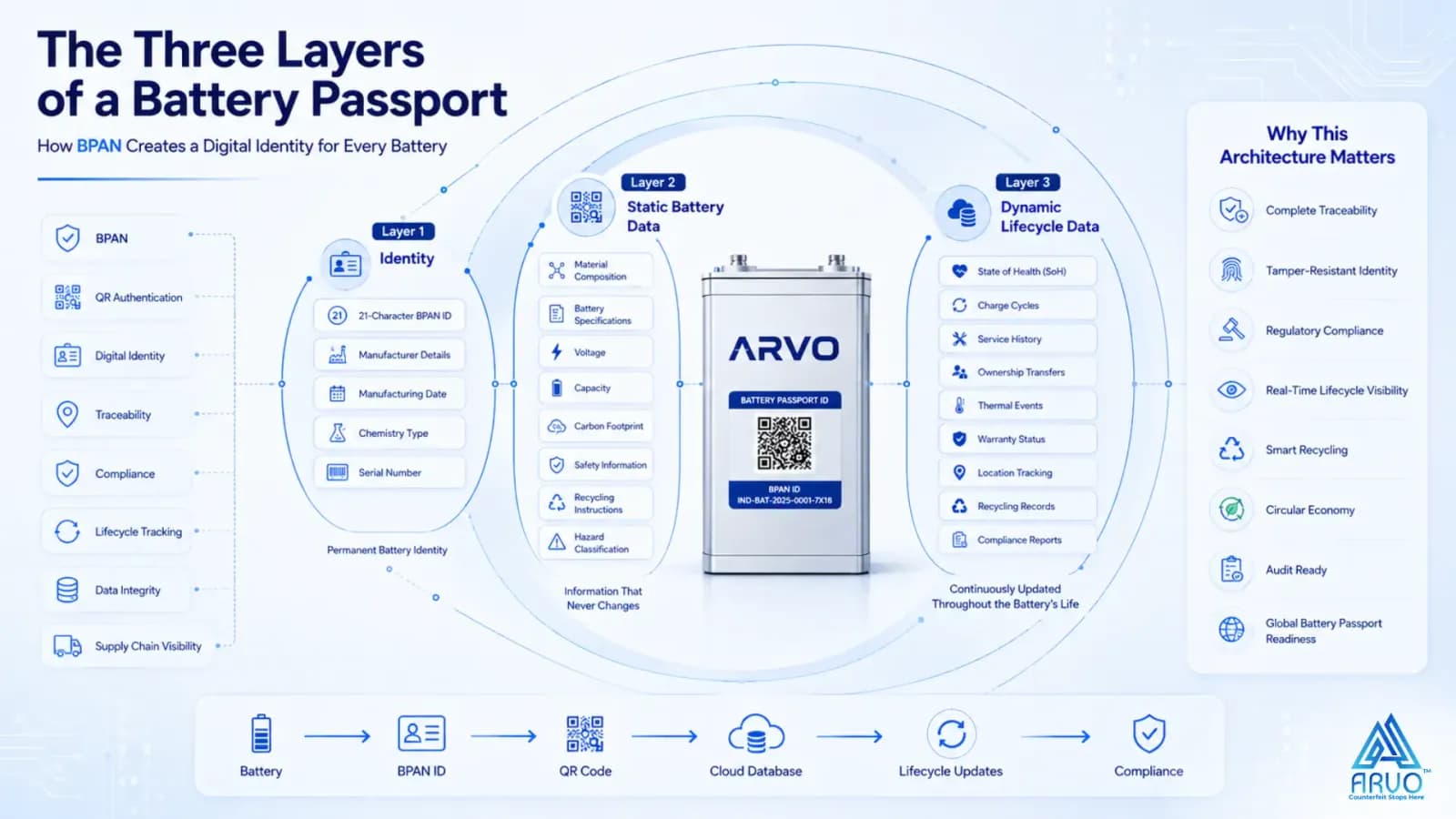
| Layer | Where it lives | What it holds | Access |
|---|---|---|---|
| Identity | 21 characters marked on the pack | Who made it, what it is, which pack it is | Public, offline |
| Static data | QR code on the pack | Materials and construction (29 parameters), carbon footprint (5 parameters) | Authorised, offline |
| Dynamic data | BPAN portal server | Status, state of health, end-of-life events (10 parameters) | Authorised, online |
Layer 1: the 21-character identity
The BPAN splits into three parts. The first 5 characters identify the manufacturer, starting with a country or region code. The next 8 describe the pack: capacity, chemistry, nominal voltage, cell origin and extinguisher class. The last 8 identify the pack itself: manufacturing date, factory code and a four-digit serial number. Anyone can read it without a network. You can take the draft's own example apart character by character in our BPAN decoder.
Layer 2: static data on the QR code
The QR code carries data that does not change over the pack's life and works offline. In the draft, it covers the pack's material composition and construction (anode, cathode, electrolyte, separator, cell type, cooling, BMS versions, disassembly method, circularity method and recyclability among them) and, in a later phase, its carbon footprint. The draft says this information is there mainly for recyclers, so they can recover materials efficiently and take packs apart safely.
Layer 3: the dynamic record on the server
The third layer keeps changing. The draft keeps it lean on purpose, with ten parameters that include the pack's category, status, state of health (SoH), the actual disassembly and circularity methods used, and a date and time stamp. Status moves through original, re-used, repurposed, remanufactured and waste. Service centres can read the record before working on a pack and upload new diagnostic results, and authorised recyclers add the outcome of treatment and material recovery. As the draft puts it, BPAN becomes a living record rather than a static label.
The draft does not list charge cycles, ownership changes or thermal events as server fields of their own. It does say SoH validation draws on charge throughput, temperature history and imbalance events, so makers who log these in their own systems will be better placed to back up the SoH they report.
How does BPAN follow a battery through its life?
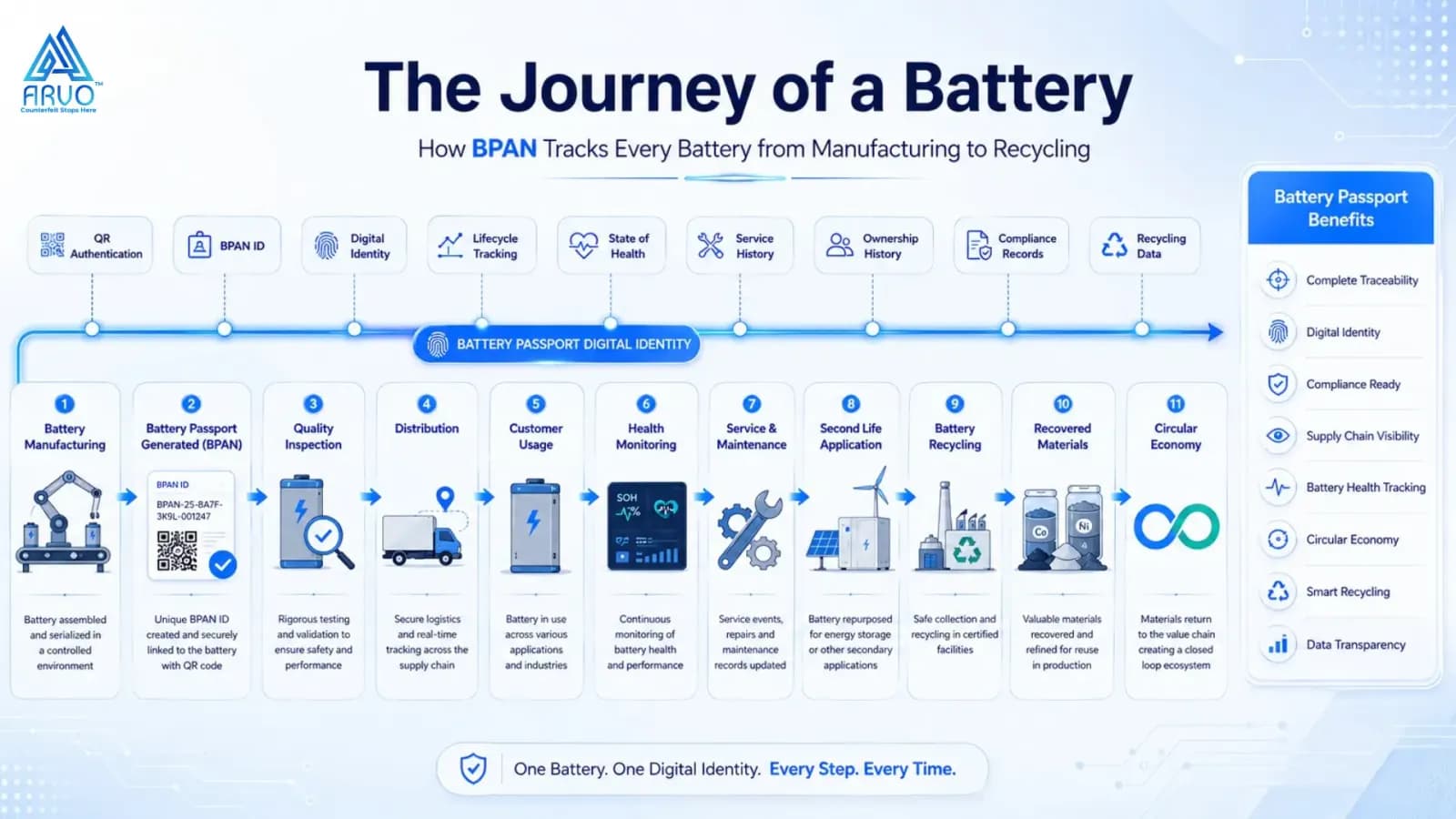
Follow one pack from start to finish.
Birth: manufacturing
A pack is assembled in Tamil Nadu. The producer generates its BPAN, encodes the QR code with its static data, marks both on the pack where they cannot be destroyed or deteriorate, and uploads the data to the BPAN portal. The pack now exists as a digital record as well as a physical one.
First life: in a vehicle
The pack goes into an electric three-wheeler in Bengaluru. In the draft's illustrative table of responsibilities, the vehicle maker records the BPAN in a dedicated field of Form 20, which feeds the VAHAN database, and prints the BPAN and QR code on the vehicle. Over the years, the pack's SoH falls and its record is updated as it is used and serviced.
Second life: repurposed
The draft's Annexure III sorts packs by SoH: operational above 80%, second life from 60 to 80%, and end of life below 60%. When this pack drops into the second-life band, it comes out of the vehicle. A buyer for stationary storage reads its record and can judge its remaining capacity and safety history from data rather than guesswork. Repurposing changes the pack's attributes, so under the draft it receives a new BPAN.
End of life: recycling
Years later, the pack's capacity falls below what its storage job needs. At a recycling plant, the recycler scans the QR code and reads its materials and disassembly method before opening it. The recovery outcome goes back to the portal, and the pack's record is complete, from the factory to recovered material.
How does India's battery passport compare with the EU's?
India is not building this alone. The EU Battery Regulation (EU) 2023/1542 requires a battery passport, reached through a QR code on the battery, for light means of transport batteries, industrial batteries above 2 kWh and electric vehicle batteries placed on the EU market from 18 February 2027 (Article 77). The same regulation sets a recycling efficiency target of 70% by average weight for lithium-based batteries by the end of 2030 (Annex XII). More broadly, the Ecodesign for Sustainable Products Regulation (EU) 2024/1781 sets the framework for digital product passports across other product groups.
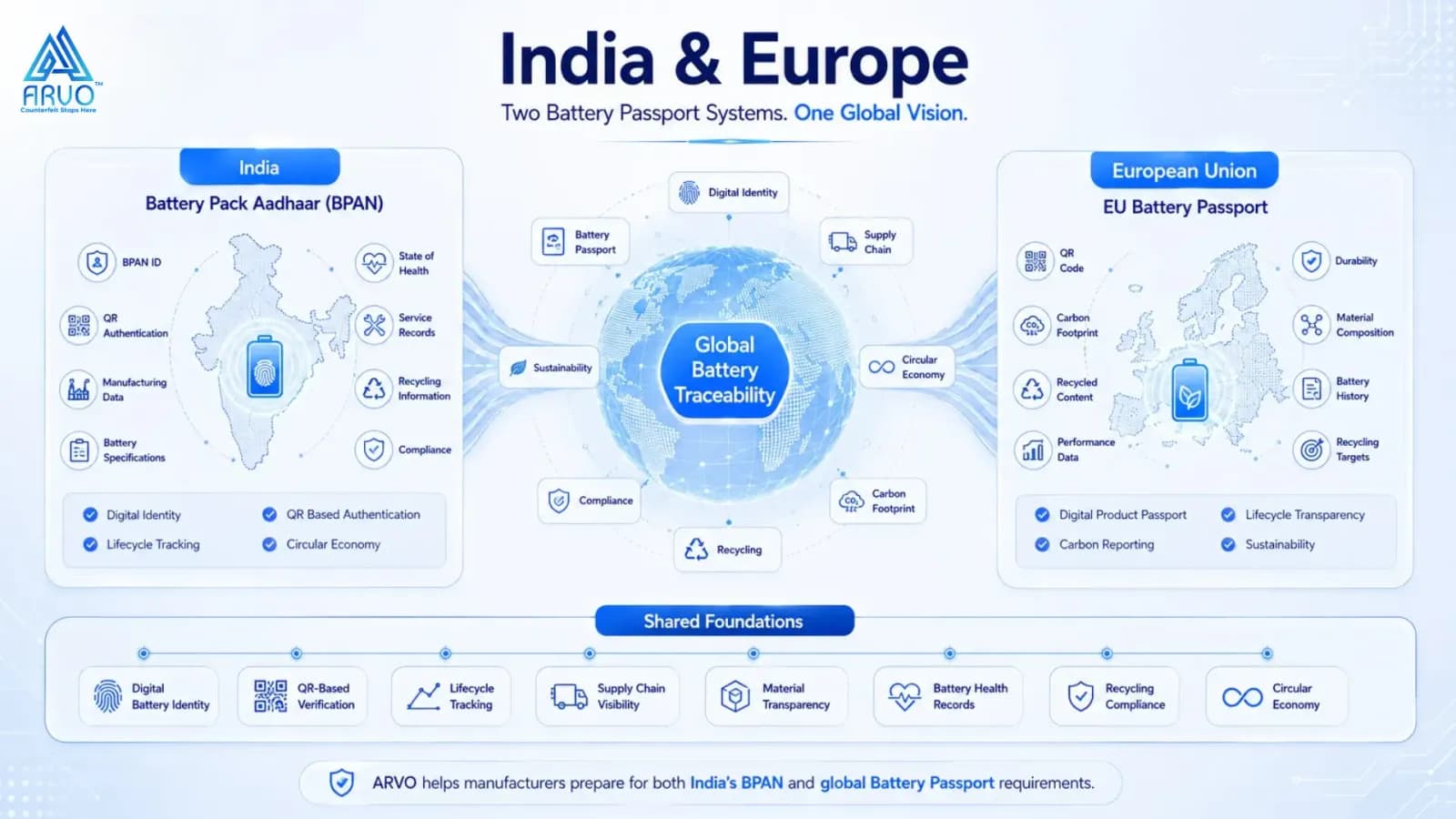
| India: BPAN (draft) | EU: battery passport | |
|---|---|---|
| Legal status | Draft guidelines, not notified | Regulation (EU) 2023/1542, in force |
| Start date | None set in the draft | 18 February 2027 |
| Batteries covered | EV batteries (L, M and N category) and industrial batteries above 2 kWh | Light means of transport, industrial above 2 kWh and EV batteries |
| Data carrier | 21-character code plus QR code | QR code linked to the passport |
| Data model | Lean: public code, static QR data, ten dynamic fields | Broader, including carbon footprint, recycled content and performance data |
The draft treats the EU regulation as useful benchmarking but deliberately avoids EU-level data burdens, given the scale of India's two- and three-wheeler market. It also says the BPAN server can be mapped to European battery passport schemas through standard APIs and field mapping, without changing anything on the physical battery or its QR code.
For an Indian exporter, that means work done for BPAN is a head start, not a finished EU passport. The data, the code on the pack and the lifecycle record overlap, but the EU asks for more. Our digital product passport page sets out what the EU requires.
What changes for manufacturers, vehicle makers, financiers and recyclers?
The battery passport changes how batteries are valued, traded, financed and recycled.
- Manufacturers. Provenance becomes something you can prove. A pack with a complete record carries its quality history with it, which matters to vehicle makers' procurement teams and to buyers abroad.
- Vehicle makers. The battery's identity becomes part of the vehicle's record, so a replaced pack, a recall or a warranty claim can be tied to the right unit.
- Financiers and used-vehicle buyers. The draft names financiers, insurers and used-vehicle buyers as stakeholders. RMI notes that buyers and financiers often lack credible visibility into a used battery's condition and struggle to price that risk. A documented SoH and history gives them something to underwrite.
- Recyclers. Knowing a pack's chemistry and disassembly method before opening it makes recycling safer and recovery more efficient. More on this in our guide to EV battery traceability across the lifecycle.
How ARVO helps
ARVO (OneARVO Ventures Pvt. Ltd., Noida) helps battery makers put the passport on the pack and keep it alive. A copy-proof NOVA code sits beside the printed BPAN and is read by any phone camera; a Vision AI model is trained to detect even a minor variation in the code, so copies fail verification, with about 99% verification accuracy and a typical rollout of about 15 days. Vision Trace records each pack on the production line with a Vision AI model, and AIC holds every scan and journey with analytics, with records secured on a blockchain so the journey can't be rewritten.
Want to see how a battery passport would work on your line? Talk to our team.
Questions answered in this article
- What is a battery passport, and how does India's version differ from Europe's?
- A battery passport is a digital record tied to one physical battery, built up from production to recycling. India's draft BPAN uses a 21-character code, a QR code and a lean server record, while the EU passport under Regulation (EU) 2023/1542 applies from 18 February 2027 and asks for broader data such as recycled content and performance.
- Which batteries would need a battery passport in India?
- The draft covers EV batteries for L, M and N category vehicles and industrial batteries above 2 kWh, with EV batteries given priority. SLI and portable batteries are outside its scope.
- How does a battery passport help the used EV market?
- It gives buyers and financiers a documented state of health and history instead of guesswork. The draft says server data lets a second-hand buyer check a pack's condition before buying or reusing it.
- What happens to a battery passport when a pack is repurposed?
- Under the draft, any change in a pack's attributes through repurposing or recycling results in a new BPAN, issued by the same or a new producer or importer. Its status on the portal changes too.
Sources
- Draft Guidelines for Implementation of Battery Pack Aadhaar System, Ministry of Road Transport & Highways committee, published by the Office of the Principal Scientific Adviser
- India introduces 'Battery Aadhaar' system to track EV batteries across lifecycle, pv magazine India
- Cabinet approves INR 18,100 crore incentives for advanced battery storage production, pv magazine India
- India's used EV battery market needs trust. Battery Aadhaar can help., RMI
- Regulation (EU) 2023/1542 concerning batteries and waste batteries, Official Journal of the European Union
- Regulation (EU) 2024/1781, Ecodesign for Sustainable Products Regulation, Official Journal of the European Union