EV Battery Traceability in India: Tracking a Pack Across Its Life
How to trace an EV battery pack in India from raw material to recycling: the six stages where data must be captured, and what the draft BPAN guidelines ask for.
By Abhijeet Kumar, ARVOPublished Updated 9 min read
In short
EV battery traceability means following each pack from raw material and cell manufacturing through pack assembly, vehicle use and second life to recycling, with records at every stage. India's draft BPAN guidelines give each pack a 21-character identity, a QR code and a portal record, but manufacturers still have to build the data capture behind them.
- Traceability needs data at six stages: raw material sourcing, cell manufacturing, pack assembly, vehicle integration, second life and recycling.
- India's draft BPAN guidelines give each pack a 21-character identity, a QR code with static data and a lean server record, but they are not yet notified.
- State of health and thermal history decide a used pack's value and safety, and thermal events cannot be reconstructed if they are not logged when they happen.
- Batch-level traceability lets a manufacturer recall only the affected packs instead of a whole product line.
- The code on the pack anchors its digital identity, so it should be one that a copy cannot pass.
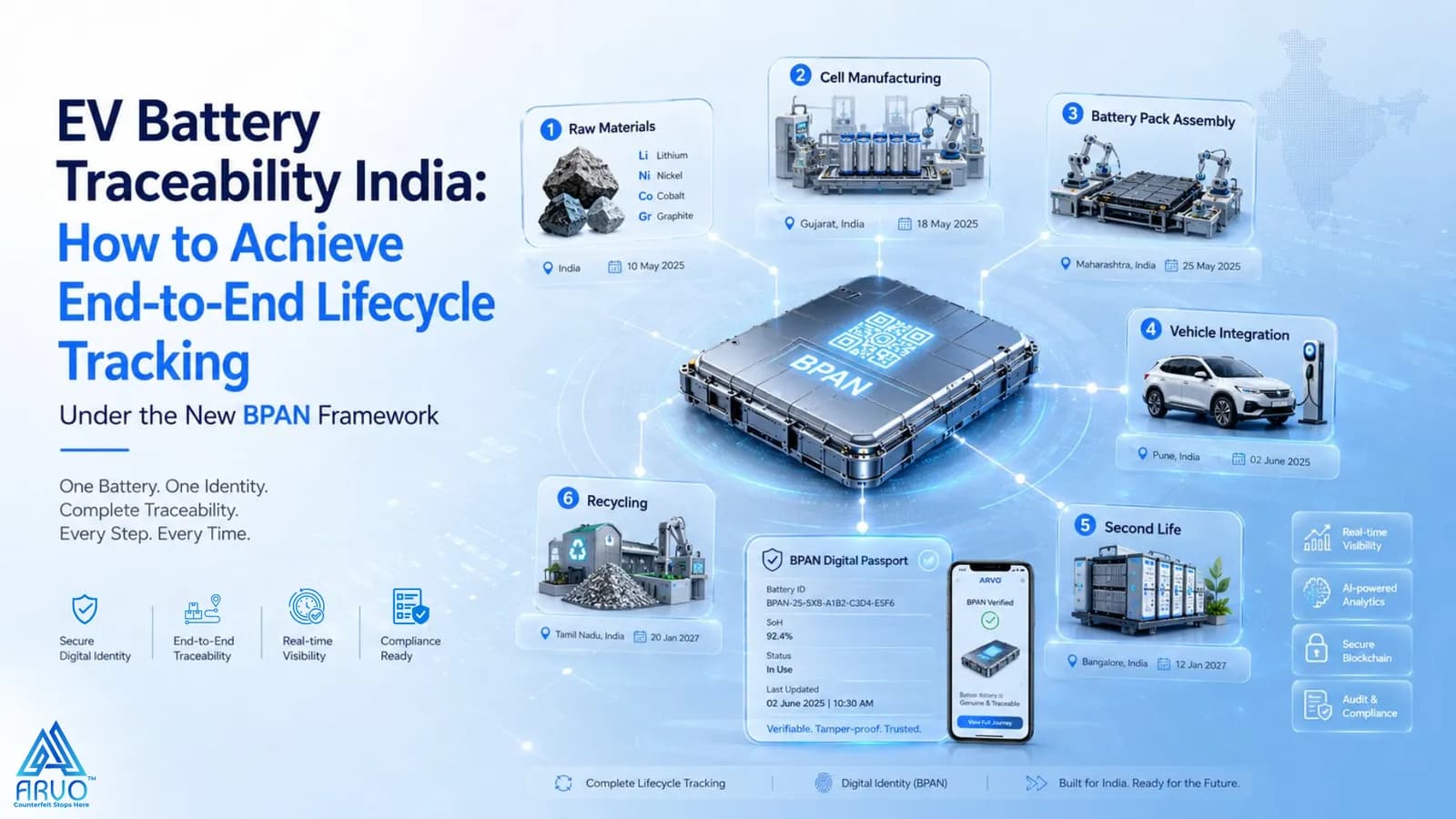
Suppose a battery pack you build today catches fire in a vehicle three years from now. Can you trace it back to its production batch, its cell supplier, its material lot and the inspection that passed it? Can you find every other pack from that batch and recall only those, within hours rather than weeks? Can you show a regulator, with records, that your process was sound on the day the pack was made?
If any answer is no, your operation has a traceability gap. India's draft Battery Pack Aadhaar framework (BPAN) is designed to close it, but an identity number on its own does not make a battery traceable. This guide maps the chain from raw material to recycling, the six stages where data has to be captured, and a practical way to build it.
What is the traceability gap in India's EV battery industry?
India is building battery manufacturing at scale. In May 2021 the Union Cabinet approved the production linked incentive (PLI) scheme for advanced chemistry cells, with an outlay of ₹18,100 crore for 50 GWh of cell capacity plus 5 GWh of niche cells, as reported by pv magazine India. And electric vehicles account for roughly 80 to 90% of India's lithium-ion battery demand, according to the draft Battery Pack Aadhaar guidelines.
Yet most battery makers can tell you what they produced, and very few can tell you where that production is now, who is using it, how healthy it is or whether it has had a safety event. That blind spot shows up in four places:
- Field failures. When a pack fails, the maker cannot always tie it to a batch and judge whether other units are at risk.
- Recycling. A recycler often does not know a pack's exact chemistry without testing it first.
- Used vehicles. Lenders and buyers struggle to value a used EV when nobody can vouch for its battery. RMI notes that financiers find it hard to price this risk.
- Compliance. When an authority asks for Extended Producer Responsibility (EPR) records, the data sits in disconnected systems or does not exist.
What does India's draft BPAN framework ask for?
The draft guidelines give each in-scope battery pack a 21-character Battery Pack Aadhaar Number, marked on the pack both as text and as a QR code, with a record on a government BPAN portal. They were drafted by a committee that MoRTH constituted by an office memorandum of 17 September 2025, and they remain a draft: the framework has not been formally notified, and the draft names the Automotive Industry Standards route as the next step. For the full breakdown, see our BPAN compliance explainer and decoder.
The draft organises battery data into three layers:
| Layer | What it holds | Who can read it |
|---|---|---|
| 21-character BPAN | Who made the pack, what it is, which pack it is | Anyone, offline |
| QR code | Static data: materials and construction, carbon footprint | Authorised stakeholders, offline |
| Portal server | Dynamic data: status, state of health, end-of-life events | Authorised stakeholders, online |
The draft describes this as a "common digital spine" that other regulations can reuse. It says BPAN supports enforcement of the Battery Waste Management Rules, 2022 and lets the government verify whether the cells in a pack were made in India, as the ACC PLI scheme requires. But the framework only defines what must be recorded. Manufacturers still have to build the capture, storage and access that make it work.
Where in the battery lifecycle must data be captured?
End-to-end EV battery traceability needs data at six stages. Each stage involves different people and produces different records, and a gap at any one of them breaks the chain.
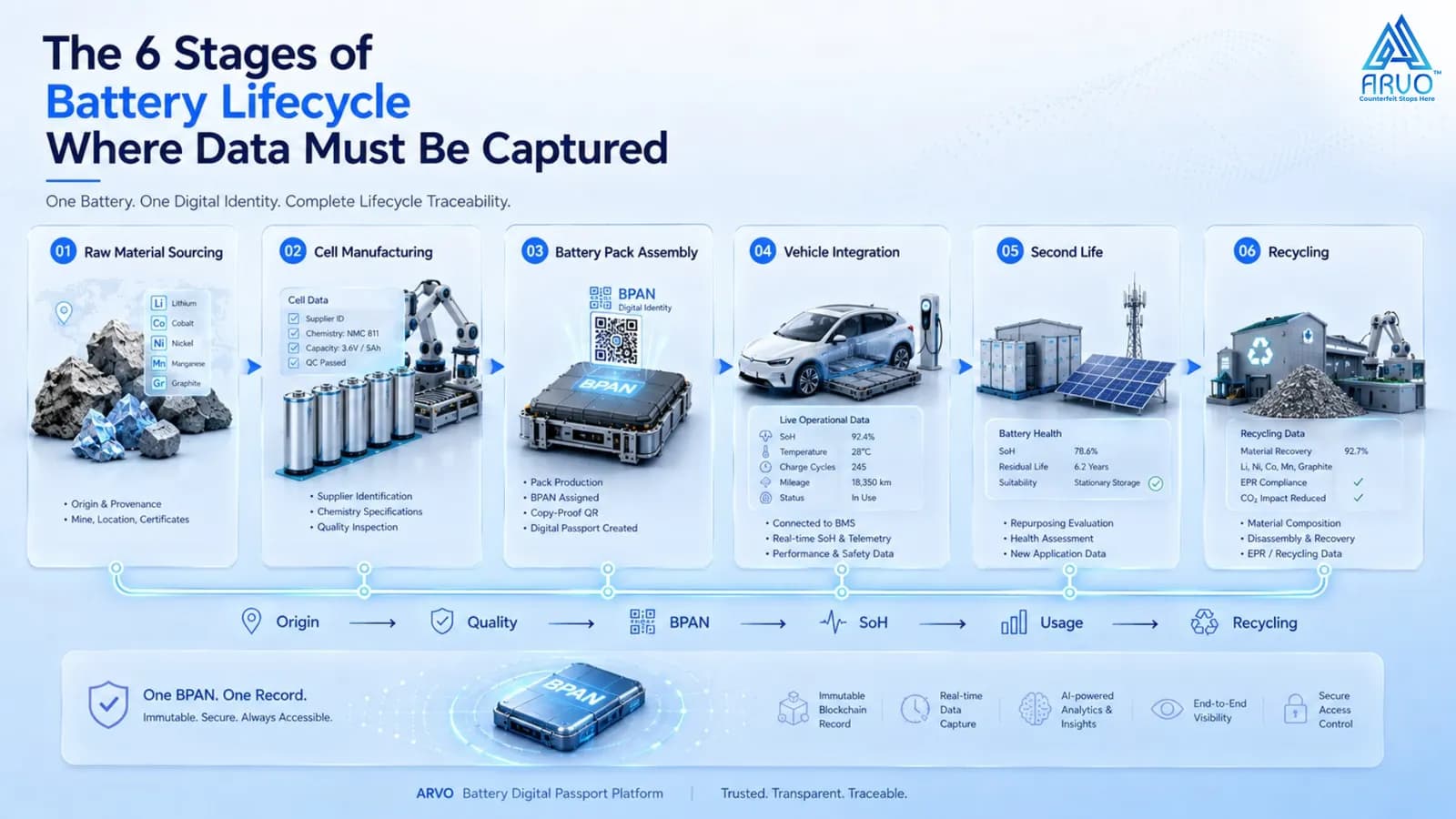
| Stage | Key records | Who creates them |
|---|---|---|
| 1. Raw material sourcing | Material origin, supplier certificates | Material suppliers, cell makers |
| 2. Cell manufacturing | Cell lot, chemistry, supplier, incoming inspection | Cell supplier, pack maker |
| 3. Pack assembly | BPAN, QR code, batch and quality records | Battery producer or importer |
| 4. Vehicle integration | BPAN linked to the vehicle, operating data begins | Vehicle maker, battery management system |
| 5. Second life | State of health, new status, new BPAN | Repurposing entity |
| 6. Recycling | Treatment and material recovery outcome | Authorised recycler |
Stages 1 and 2: raw material provenance and cell manufacturing
The chain starts before the battery exists, with the lithium, nickel, cobalt, manganese and graphite that become its cells. Knowing where materials come from, and being able to prove it, protects you in supply disputes, ESG audits and any future responsible-sourcing rules. In the draft's third phase, the carbon footprint data on the QR code also splits out the share that comes from raw material acquisition.
When cells arrive, record each lot against its supplier, chemistry, certifications and incoming inspection results. The draft obliges cell and module suppliers to give pack makers the information they need, and the cell origin country is written into the 21-character BPAN itself.
Stages 3 and 4: pack assembly and vehicle integration
Pack assembly is where the BPAN is born. Under the draft, the producer or importer assigns the number, marks it on the pack as text and as a QR code, and uploads the data to the BPAN portal. The mark must sit in a clearly visible, accessible place where it cannot be destroyed or deteriorate.
This is also where the choice of code matters. A standard printed code can be photographed and reprinted, so a copied label can make a fake or rewrapped pack look like a real one. If the code is the anchor of the pack's digital identity, it should be one that a copy cannot pass. Our guide to battery QR codes under BPAN covers this in detail.
When the pack goes into a vehicle, the draft's illustrative table of responsibilities has the vehicle maker enter the BPAN in a dedicated field of Form 20, which feeds the VAHAN database, and print the BPAN and QR code on the windshield or vehicle body. If a pack is later replaced, the vehicle's record moves to the new pack's BPAN. From this point the battery management system starts producing operating data: state of health, charge throughput, cell balancing and temperature.
Stages 5 and 6: second life, recycling and closing the loop
The draft sorts packs by state of health (SoH) in its Annexure III: operational above 80%, second life from 60 to 80%, and end of life below 60%. When a pack leaves the vehicle, a documented history decides its value. A pack with a known SoH, usage record and clean safety log can be sold for stationary storage or backup power at a price backed by data. A pack without one is a risk that buyers discount or refuse.
Under the draft, any change in a pack's attributes through repurposing or recycling results in a new BPAN, issued by the same or a new producer. Keep the link between the old number and the new one in your own records, so the pack's earlier life is not lost.
At end of life, the recycler scans the QR code to read the pack's materials, construction, disassembly method and recyclability before opening it. Recyclers authorised by the government then add the outcome of treatment and material recovery to the portal, closing the loop. That trail also supports the EPR obligations producers carry under the Battery Waste Management Rules, 2022, which today are often met with scattered paperwork.
Which battery data matters most?
Not all lifecycle data carries the same weight. Two streams matter most for safety, value and compliance.
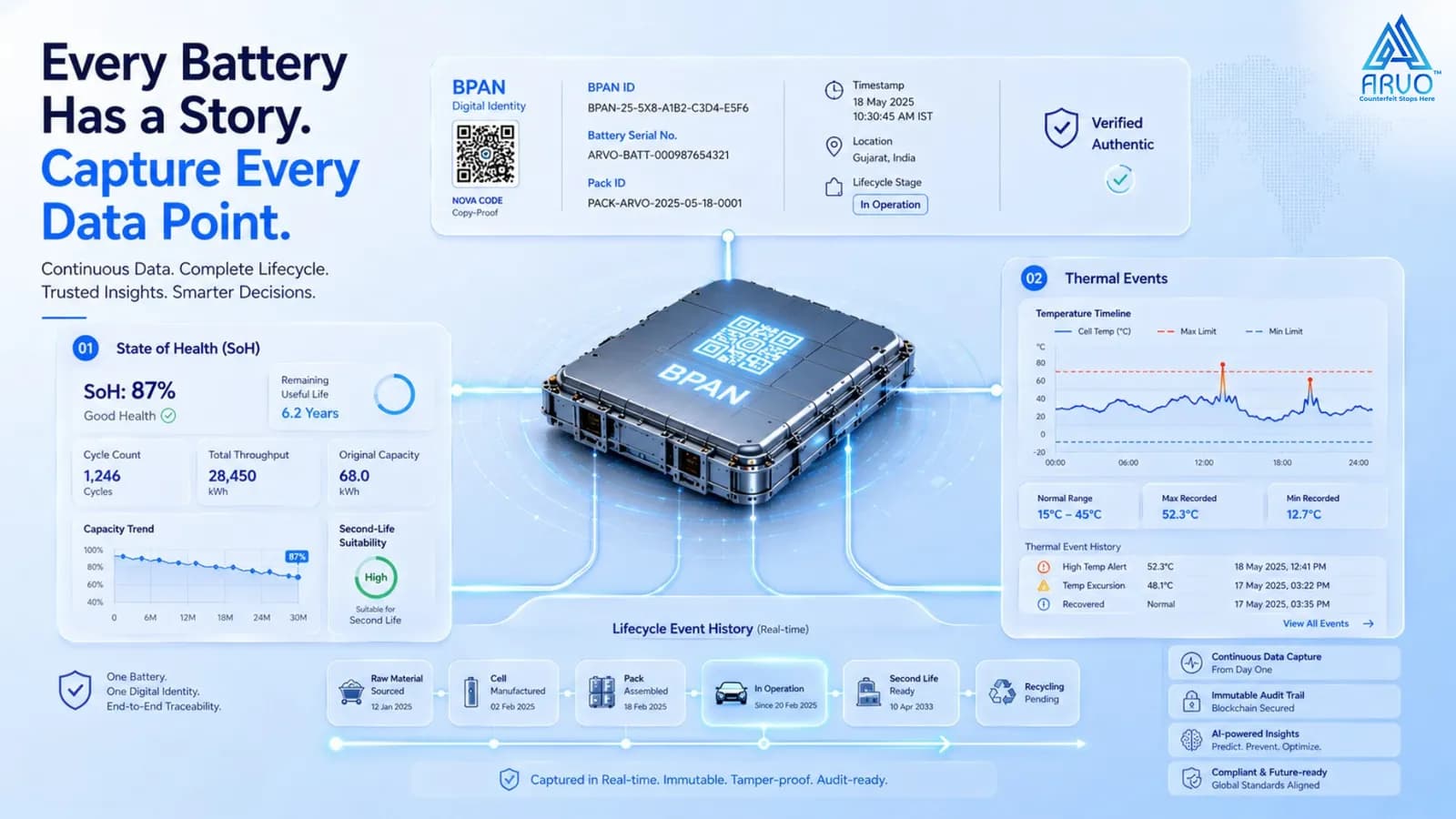
State of health: the battery's vital sign
SoH is a pack's current capacity as a share of its original rated capacity. Tracked over time, it lets you predict remaining useful life, decide second-life suitability and set a fair price for a used battery or a used EV. The draft's server layer keeps SoH alongside status, so a second-hand buyer can check a pack's condition before buying or reusing it. It also says the government will develop the detailed method for validating SoH separately.
Thermal events: the record you cannot rebuild
A pack with no recorded thermal events is a different risk from one with three minor excursions, and both differ from a pack with one serious incident. This record cannot be reconstructed later. If an event is not logged when it happens, it is gone.
The draft keeps its server layer deliberately lean, with ten parameters, and does not list thermal events as a field of their own. But it says SoH validation draws on temperature history, imbalance events and cell-level anomalies, and that authorised service centres should check a pack's record for abnormal events before working on it. So treat SoH and thermal logging as requirements in your own system from the day a pack enters service, even where the portal asks for less.
How does traceability make battery recalls faster?
Without traceability, a single incident can force a recall of a whole product line. With it, you trace the failed pack to its batch, find every other pack from that batch through its serial records, judge whether the fault is batch-specific or systemic, and recall only the units affected. The recall is smaller, cheaper and faster, and the damage to your reputation is easier to contain. Our EV battery industry page shows what this looks like for pack makers.
How can a battery maker start building traceability now?
You do not need the final rules to begin. A practical sequence:
- Map your data against the three layers. List what you already capture for the BPAN, the QR code and the portal, and where the gaps are.
- Get supplier data flowing. Agree with cell, module and BMS suppliers what they will send for each lot, in what format.
- Give every pack a unique, durable identity at assembly. Record each pack on the line and tie it to its batch, cells and inspection results.
- Choose a code that resists copying. The code on the pack is the entry point to everything else, so it has to be trustworthy.
- Keep one record per pack after it ships. Log scans by vehicle makers, service centres and recyclers, plus SoH and safety events, against the same identity.
- Run a pilot batch. Check that codes read correctly, the data is complete and the records flow, then scale up.
These steps also help with the EU battery passport, which applies to electric vehicle batteries placed on the EU market from 18 February 2027 under Article 77 of the EU Battery Regulation. Our digital product passport page explains what it asks for.
How ARVO helps
ARVO (OneARVO Ventures Pvt. Ltd., Noida) gives each pack a copy-proof NOVA code that any phone camera can read; a Vision AI model is trained to detect even a minor variation in the code, so copies fail verification, with about 99% verification accuracy and a typical rollout of about 15 days. Vision Trace records each pack on the production line with a Vision AI model, and AIC holds every scan and journey with analytics, from the factory to the recycler. Records are secured on a blockchain so the journey can't be rewritten.
Ready to trace every pack you make? Talk to our team.
Questions answered in this article
- What is end-to-end EV battery traceability?
- It is the ability to follow a battery pack from raw material sourcing and cell manufacturing through pack assembly, vehicle use and second life to recycling. Each stage adds records to the same pack identity, so a gap at any stage breaks the chain.
- What data must manufacturers capture at the production stage?
- Under the draft BPAN guidelines, the producer assigns the 21-character BPAN, encodes static data such as materials, construction and carbon footprint in the QR code, marks both on the pack and uploads the data to the BPAN portal. Linking each pack to its batch, cell lots, suppliers and inspection results makes the record useful for recalls and audits.
- How does battery traceability help with recalls?
- It lets a manufacturer trace a failed pack to its production batch, find every other pack from that batch and recall only the affected units. That keeps a recall smaller, faster and cheaper than recalling a whole product line.
- Is BPAN mandatory for EV battery makers in India?
- Not yet. The Battery Pack Aadhaar System is set out in draft guidelines that have not been formally notified, with no compliance dates or penalties. The draft recommends taking it forward through the Automotive Industry Standard route.
- Does the BPAN portal record thermal events?
- The draft keeps the server record to ten parameters and does not list thermal events as a field of their own, but it says state of health validation draws on temperature history and imbalance events. Manufacturers should log thermal events in their own systems from the day a pack enters service.
Sources
- Draft Guidelines for Implementation of Battery Pack Aadhaar System, Ministry of Road Transport & Highways committee, published by the Office of the Principal Scientific Adviser
- Cabinet approves INR 18,100 crore incentives for advanced battery storage production, pv magazine India
- India's used EV battery market needs trust. Battery Aadhaar can help., RMI
- Regulation (EU) 2023/1542 concerning batteries and waste batteries, Official Journal of the European Union