Non-Cloneable QR Codes vs. Holograms highlights a critical shift in how industries protect product authenticity. As operations become increasingly digital, secure product identification and reliable track-and-trace capabilities are more vital than ever. Counterfeiting now costs global industries more than USD 500 billion annually, and the traditional defenses, holograms, barcodes, and standard QR codes, are no longer sufficient. While these methods provide a basic level of protection, none can deliver failsafe security against today’s sophisticated counterfeiters.
This is where Non-Cloneable QR Codes (NOVA Codes) redefine the standard. They combine the universal accessibility of QR technology with unprecedented cryptographic security, enabling instant verification that cannot be replicated. Unlike holograms or static codes, NOVA Codes are inherently resistant to cloning, providing a modern, scalable foundation for authenticity, traceability, and trust in a digital-first supply chain.
The Drawbacks of Traditional Solutions
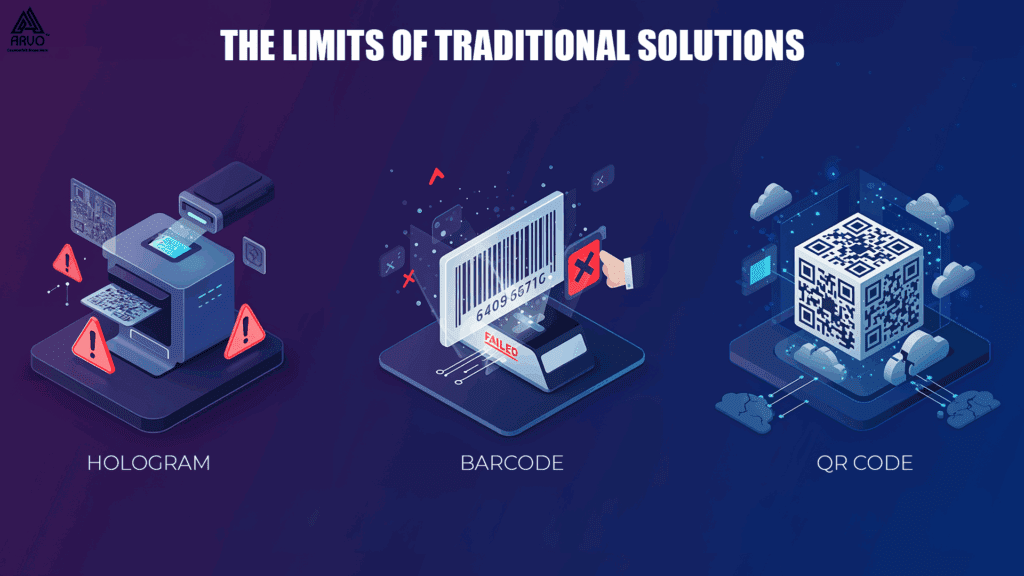
1. Holograms: Obvious but Easy to Copy
Holograms are the most common anti-counterfeit stamps. With current printing technologies,
however, these can be copied nearly flawlessly. Consumers are left with the use of visual
instinct, which is far from guaranteed.
2. Barcodes: Useful but Easy
Barcodes facilitate immediate identification but hold very little information and offer no copy
deterrent. Anyone can reproduce a barcode, rendering it ineffective as a security control.
3. Standard QR Codes: Convenient but Flawed
QR codes link products to digital information, but they are their own downfall through being
reproducible by anyone who just happens to possess a camera phone. As a result, they provide
convenience but very little real security.
Why Non-Cloneable QR Codes are Special
● Unlike holograms, barcodes, or standard QR codes, Non-Cloneable QR Codes are
physically unclonable.
● Every code is generated randomly with genuine optical variability and a cryptographic
embedded identity, a digital fingerprint.
● Scanned, the system not only reads product information but also verifies the authenticity
of the code itself. Any copy attempt is doomed to fail immediately, leaving counterfeiters
out in the cold.
Advantages Over Other Labels
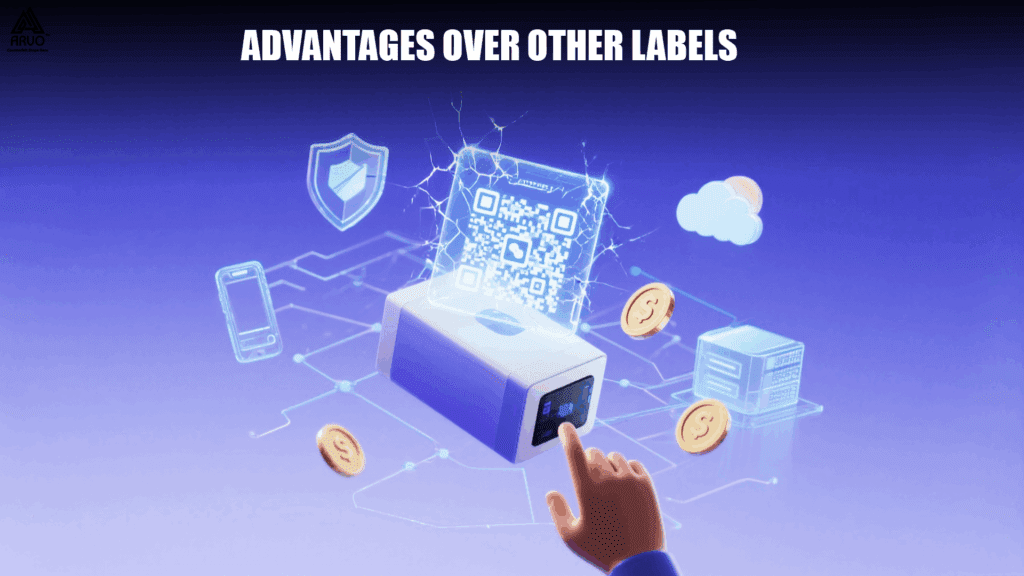
● Tamper-evident at source: Authenticates the code itself, not just the associated
information.
● Scalable and user-friendly: Scannable using any smartphone, without additional
hardware.
● Real-time tracking: Each scan is added to a secure server, offering businesses visibility into
product movement and diversion attempts.
● Cost-effective: Built on top of existing QR code infrastructure, enabling mass adoption
without requiring major changes.
The Future of Product Authentication
Automotive, Pharma, Chemicals, and Industrial Equipment– counterfeiting attacks face
industries across the board. The answer lies not in updating outdated systems but embedding
security into the identifier itself. Non-Cloneable QR Codes bridge the gap, offering consumer
convenience and uncompromising brand security. They bring transparency, trust, and scalability
under one solution.
How ARVO Helps
Let’s imagine a consumer purchases what they believe to be your premium. They’ve trusted
your brand, saved to purchase it, and made up their mind to purchase. But after they open a
package, the quality is bad, performance is low and unawarely, they’ve ended up with a
counterfeit. It damages trust but also loses a customer permanently.
Now how can ARVO help you here? Basically ARVO will prevent this from happening by
embedding security at the product level. With solutions designed for scalability and real-world
supply chains, ARVO helps brands safeguard both their products and their customer
relationships.
With ARVO, businesses receive:
● Non-Cloneable QR (NOVA) Code: Physically unclonable, cryptographically secure,
scannable with any smartphone. Each scan authenticates the code itself and cannot be
duplicated.
● Tamper-Evident Labels: Protect packaging integrity and provide visible assurance if a
product has been opened or altered.
● Imagehash Verification: Advanced computer vision program to detect illegal
reproductions or distorted products.
● Cloud-based supply chain traceability: End-to-end visibility with real-time tracking
enables brands to monitor movement of products, recognize diversion, and interact with
customers where they authenticate.
Each scan is integrated into ARVO Integrated Cloud for real-time authentication, fraud
detection, and consumer engagement. ARVO with rapid deployment, smartphone enablement,
and ERP integration renders product verification convenient, measurable, and future-proof.
Because if brand reputation and customer trust is involved, then security can’t be an
afterthought but a design-in.
Future-proof your supply chain with ARVO.
FAQ
● Which industries are benefited most?
Automotive & Auto Components, Pharmaceuticals, Chemicals and Industrial Equipment
Manufacturing all benefit from real-time fraud avoidance, traceability, and consumer
engagement.
● Are non-cloneable QR codes expensive to roll out?
No. They do not require additional infrastructure, only existing QR code infrastructure, thus
making them cost-efficient and easy to roll out at scale.
● How are they different from other anti-counterfeit labels?
They combine optical variability (a fingerprint-like attribute) with encryption. Each scan checks
The product information and the code authenticity are used to prevent duplication at the source.