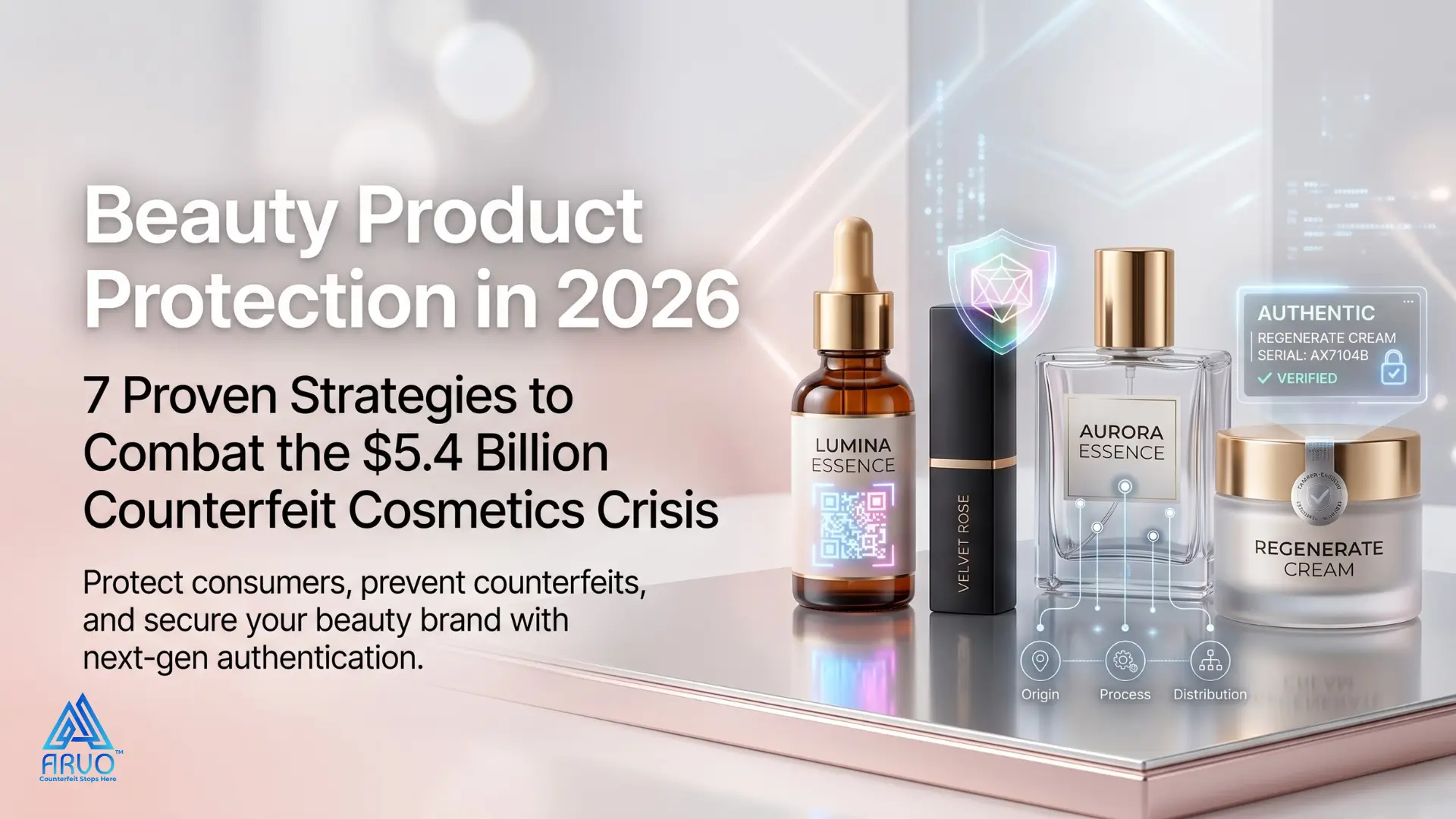
Beauty product protection has moved from a compliance checkbox to a boardroom-level priority. The reason is alarming: the global cosmetics industry loses approximately $5.4 billion every year to counterfeit cosmetics, according to the OECD and the Personal Care Products Council (PCPC). Fake lipsticks laced with lead, counterfeit serums contaminated with industrial-grade chemicals, and fraudulent perfumes containing probable carcinogens are not edge cases. They are a systemic threat affecting every beauty brand, from luxury houses to emerging D2C labels.
The European Union Intellectual Property Office (EUIPO) estimates that 10.6% of all beauty and personal care sales in the EU are lost to counterfeiting, translating to approximately €7 billion in annual revenue erosion. In the United States, the FDA estimates that up to 20% of cosmetics sold online are counterfeit. And in India, consumer surveys reveal that 25–30% of beauty products in the market may be spurious or fake.
For beauty brand decision-makers, the question is no longer whether counterfeiting will affect your brand. It is how quickly you can deploy a beauty product protection strategy that safeguards your consumers, your revenue, and your reputation.
This guide breaks down the full scope of the counterfeit cosmetics crisis and delivers 7 actionable, technology-driven strategies that leading beauty brands are implementing in 2026 to protect their products from source to shelf.
The Scale of the Counterfeit Cosmetics Crisis: Numbers Every Beauty Brand Must Know
Before examining solutions, it is critical to understand why beauty product protection demands urgent attention. The data paints a concerning picture across every market and product category.
- $5.4 billion in annual revenue lost by the cosmetics industry to counterfeit products (PCPC/OECD).
- 10.6% of all EU beauty sales are displaced by fake products, costing the sector approximately €7 billion per year (EUIPO).
- Cosmetics rank in the top 8 most counterfeited product categories globally in terms of customs seizures (OECD).
- 1 in 3 US consumers has unknowingly purchased a counterfeit beauty or personal care product (Smart Protection Research).
- 70% of beauty brands discover counterfeit versions of their products on digital marketplaces (Smart Protection).
- K-beauty counterfeit damages reached $15.1 million in just 9 months of 2025, a 24-fold surge from 2024 (Korea Customs Service).
- The anti-counterfeit cosmetic packaging market is projected to reach $215.74 billion in 2026, growing at a 12.86% CAGR to $639.35 billion by 2035 (Precedence Research).
These numbers make one thing clear: counterfeit cosmetics are not a fringe problem. They represent one of the fastest-growing segments of the global counterfeit economy, demanding sophisticated, multi-layered beauty brand protection solutions.
Why Fake Beauty Products Are a Public Health Emergency
The threat of fake beauty products extends far beyond revenue loss. Counterfeit cosmetics routinely contain hazardous substances that pose direct health risks to consumers.
According to the U.S. Department of State and the FDA, seized counterfeit cosmetics have been found to contain:
- Lead and mercury in counterfeit lipsticks and skin-lightening creams, both known neurotoxins that accumulate in the body over time.
- DEHP (Di-2-ethylhexyl phthalate) in counterfeit perfumes, classified by the EPA as a probable human carcinogen.
- Dangerous bacteria and biological contaminants including fecal matter, found in counterfeit foundations and concealers manufactured in unregulated facilities.
- Arsenic and beryllium in counterfeit eye makeup products, capable of causing chemical burns, eye infections, and long-term vision damage.
- Industrial-grade chemicals substituted for cosmetic-grade ingredients in counterfeit skincare, leading to permanent scarring, severe allergic reactions, and hormonal disruption.
In 2023, U.S. Customs and Border Protection alongside the FDA seized over $700 million worth of counterfeit cosmetics entering the country. CBP data from FY 2023 shows that 31% of all intercepted counterfeit goods were beauty and personal care products, making cosmetics one of the single largest categories of seized fakes.
For beauty brands, every counterfeit product that reaches a consumer is not just a lost sale. It is a potential health incident tied directly to your brand name. This makes cosmetic product authentication not merely a business strategy but an ethical obligation.
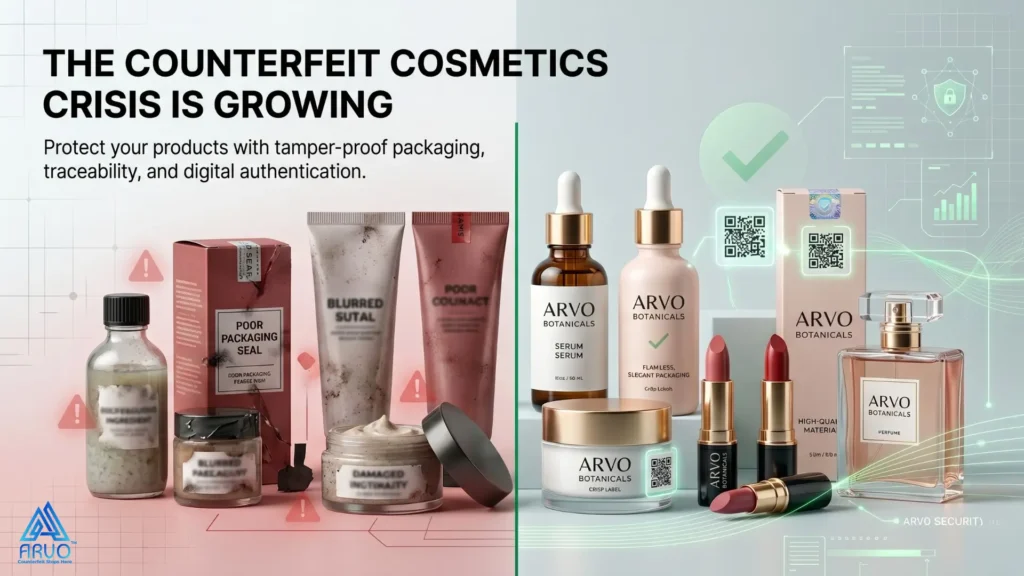
7 Proven Beauty Product Protection Strategies for 2026
Effective beauty product protection requires a multi-layered approach that combines physical security, digital authentication, supply chain visibility, and consumer engagement. Below are 7 strategies that leading cosmetics brands are deploying in 2026.
1. Deploy Non-Cloneable QR Codes with Cryptographic Authentication
Standard QR codes can be photographed and replicated in minutes. Non-cloneable QR codes, such as ARVO’s Nova technology, embed a Cryptographic Data Pattern (CDP) within the code structure itself. This means that even if a counterfeiter copies the visual appearance of the QR code, the cryptographic layer fails verification upon scanning.
For cosmetics brands, this is the foundational layer of beauty product protection. Each product unit, whether a lipstick, serum, or perfume bottle, receives a unique, serialized code that links to blockchain-backed authentication records. This enables batch-to-unit traceability across the entire cosmetic supply chain.
2. Integrate Tamper-Evident Labels on All Beauty Packaging
Tamper-evident labels serve as the first physical barrier against product substitution and refilling, two of the most common counterfeiting tactics in the beauty industry. Multi-layer tamper protection, such as ARVO’s PHANTOM labels, combines destructible materials, non-cloneable QR codes, and heat-activated ink to instantly reveal any tampering attempt.
This is particularly important for premium skincare and fragrance products, where counterfeiters frequently purchase genuine packaging from the secondary market and refill it with inferior or dangerous formulations. A robust anti-counterfeiting cosmetic packaging strategy must include tamper evidence as a non-negotiable layer.
3. Embed Invisible Watermarks for Premium Beauty Products
Luxury and premium beauty brands face a unique challenge: their packaging is part of the brand experience, and any visible security feature can detract from the aesthetic. Invisible watermarking technology, such as ARVO’s Spector solution, embeds non-intrusive, covert authentication markers directly into product labels or packaging artwork.
These watermarks are undetectable by the naked eye, cannot be reproduced by standard printing methods, and can be verified through a specialized app. This provides a second layer of cosmetic product authentication that operates independently of the QR code, creating redundancy that significantly increases the difficulty for counterfeiters.
4. Implement Blockchain-Powered Supply Chain Traceability
Blockchain traceability creates an immutable, transparent record of every product movement from manufacturing to the consumer’s hands. For the beauty industry, this means every batch of ingredients, every production run, and every distribution transfer is permanently logged on a decentralized ledger that cannot be altered or falsified.
Platforms such as ARVO’s AIC (ARVO Integrated Cloud) provide beauty brands with a comprehensive dashboard that tracks authentication scans, supply chain movements, and consumer engagement in real time. This level of cosmetic supply chain transparency is rapidly becoming a competitive differentiator, as 62% of consumers now check product authenticity before purchasing, and this number is even higher in premium beauty segments.
5. Use Permanent Engraving for Glass and Metal Beauty Packaging
For fragrance bottles, luxury skincare jars, and any beauty product using glass or metal packaging, label-based authentication alone may not suffice. Technology like ARVO’s Zora uses permanent laser engraving to embed unclonable authentication markers directly onto the packaging surface.
Unlike adhesive labels, engravings cannot be removed, transferred, or replicated. They survive handling, cleaning, and environmental exposure, providing lifelong beauty product protection for high-value items. This is especially relevant for the fragrance segment, where counterfeit perfumes containing the carcinogen DEHP have been documented by the EPA and the U.S. Department of State.
6. Prepare for EU Digital Product Passport (DPP) Compliance
The European Union’s Digital Product Passport regulation will require beauty and cosmetics brands selling in the EU to provide comprehensive, digitally accessible product information covering ingredients, manufacturing origin, sustainability practices, and supply chain provenance. While the exact enforcement timeline for cosmetics-specific DPP is still being finalized, regulatory experts recommend that brands begin implementation at least 18 months before expected deadlines.
For beauty brands exporting to Europe, DPP readiness is not optional. It is a market access requirement. Brands that invest in beauty product protection infrastructure now, including serialization, blockchain traceability, and consumer-facing transparency portals, will be positioned to comply with DPP mandates without costly last-minute overhauls.
7. Turn Product Authentication into a Consumer Engagement Channel
Authentication technology should not be a one-way security gate. Forward-thinking beauty brands are transforming every product scan into a consumer engagement opportunity. When a customer scans a protected product, they can receive the verification result alongside personalized content: skincare tips, ingredient origin stories, sustainability credentials, and loyalty rewards.
This approach directly addresses a critical market reality. Research from Smart Protection found that 94% of consumers are concerned about fake beauty products, yet 20% still intentionally purchase counterfeits, often because they do not have an easy, trustworthy way to verify authenticity. By making verification seamless and rewarding, brands convert a security measure into a loyalty-building touchpoint.
ARVO’s AIC platform enables custom product pages for every SKU, providing beauty brands with a direct-to-consumer channel embedded in the product itself. This is where beauty brand protection meets customer experience, and it is what separates reactive security from proactive brand strategy.
The Cost of Inaction: What Happens When Beauty Brands Ignore Counterfeiting
Brands that delay beauty product protection face compounding consequences:
- Revenue erosion: With 10.6% of EU beauty sales displaced by fakes (EUIPO), a mid-sized brand generating €50 million in EU revenue is losing approximately €5.3 million annually to counterfeits.
- Brand abandonment: 20% of consumers who unknowingly purchase a counterfeit stop buying from the genuine brand entirely (Smart Protection), representing a permanent loss of customer lifetime value.
- Legal and regulatory exposure: The U.S. MoCRA (Modernization of Cosmetics Regulation Act) and EU cosmetics regulations increasingly hold brands accountable for products bearing their name, regardless of whether they manufactured them.
- Consumer safety liability: A single health incident caused by a counterfeit product bearing your brand can trigger recalls, lawsuits, and irreversible reputational damage.
Why a Multi-Layered Approach to Beauty Product Protection Matters
No single technology can defeat counterfeiting alone. Counterfeiters adapt. A standalone QR code can be photographed and reprinted. A hologram can be visually mimicked. A basic barcode can be cloned.
This is precisely why the most effective beauty product protection strategies deploy multiple, interlocking layers of defence. When a brand combines non-cloneable QR codes (overt), invisible watermarks (covert), tamper-evident labels (physical), blockchain traceability (digital), and consumer engagement (behavioral), it creates a security ecosystem where defeating one layer still leaves four others intact.
ARVO’s suite of products, Nova, Spector, Zora, PHANTOM, and the AIC cloud platform, is designed to deliver exactly this layered approach, purpose-built for the unique challenges of the beauty and cosmetics industry.
Protect Your Beauty Brand Before the Next $5.4 Billion Is Lost
The counterfeit cosmetics crisis is not going to resolve itself. With the anti-counterfeit cosmetic packaging market projected to grow from $190.75 billion in 2025 to $639.35 billion by 2035, the industry is signaling a clear verdict: beauty product protection is not optional. It is a strategic investment that protects revenue, safeguards consumers, and future-proofs regulatory compliance.
Brands that act now will secure their position. Brands that wait will watch their market share, their reputation, and their consumer trust erode, one counterfeit product at a time.
Ready to Build Your Beauty Product Protection Strategy?
ARVO provides end-to-end cosmetic product authentication and supply chain traceability solutions for beauty brands of all sizes. From non-cloneable QR codes to blockchain-powered traceability, our multi-layered platform is built for the unique challenges of the beauty industry.
Request a free beauty brand protection assessment at Contact us or email info@onearvoventures.com
FAQ’s
How can beauty brands protect products from counterfeiting?
Beauty brands can protect products by using a layered anti-counterfeit strategy that includes non-cloneable QR codes, tamper-evident labels, invisible watermarks, blockchain-based supply chain tracking, and direct consumer authentication tools.
Why are counterfeit beauty products dangerous for consumers?
Fake beauty products often contain harmful substances such as lead, mercury, bacteria, and industrial-grade chemicals. These can cause skin damage, allergic reactions, infections, and long-term health issues.
What is the best anti-counterfeit technology for cosmetics in 2026?
The most effective approach in 2026 is a multi-layered system that combines physical packaging protection, digital authentication, and real-time supply chain traceability. Non-cloneable QR codes and blockchain tracking are currently leading solutions.
How do QR codes help in beauty product authentication?
Advanced QR codes with cryptographic protection allow consumers and brands to instantly verify whether a product is genuine. They also help track product movement, detect duplicate scans, and improve transparency.
Do beauty brands need to prepare for Digital Product Passport (DPP) regulations?
Yes. Beauty brands selling in Europe should start preparing for DPP compliance now. Early adoption of serialization, traceability systems, and digital product information can help avoid future regulatory risks and market disruptions.