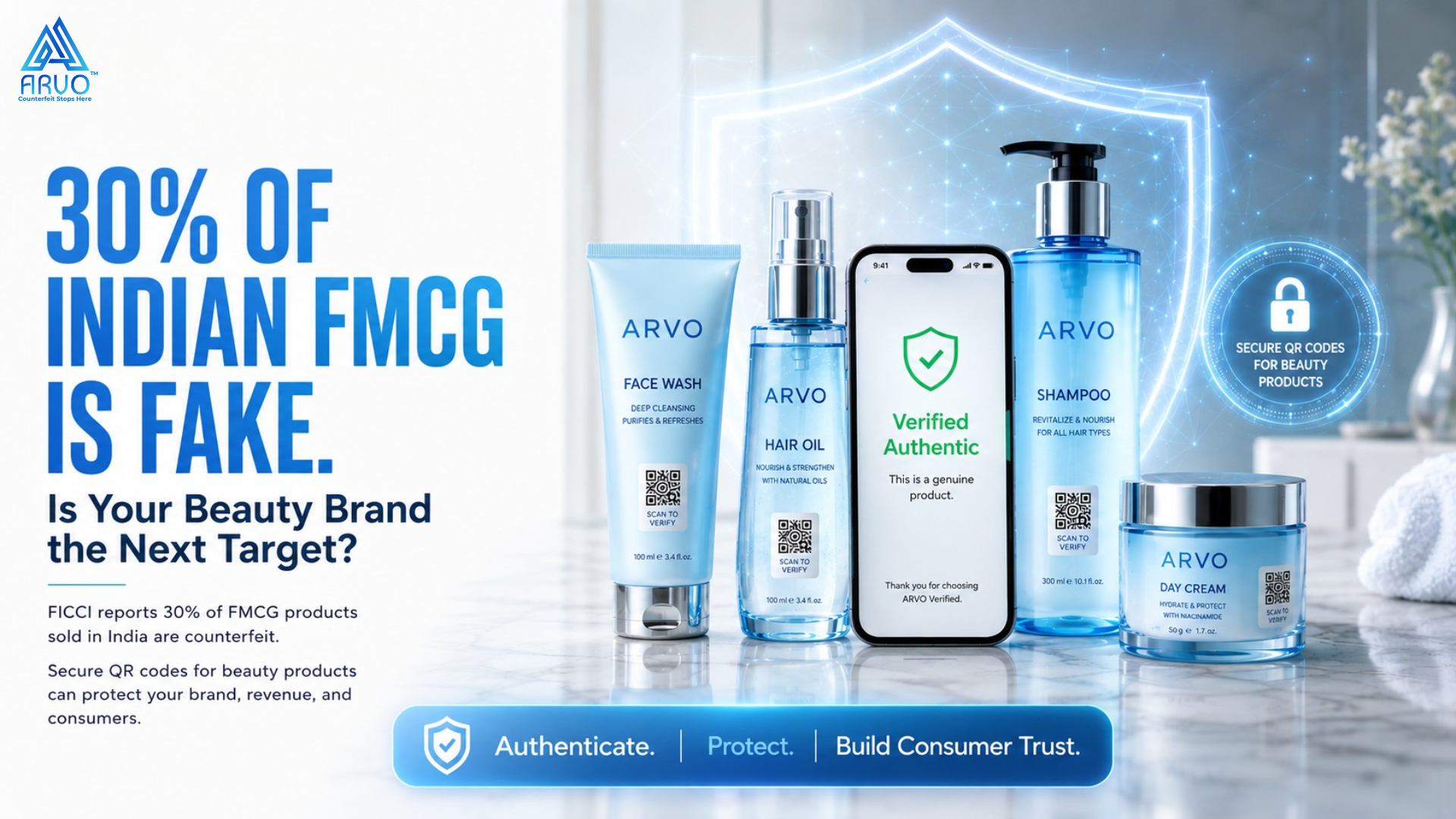
The numbers released by FICCI CASCADE and corroborated by the ASPA/CRISIL Intelligence “State of Counterfeiting in India 2025” report paint an alarming picture for every beauty and cosmetics manufacturer operating in India. Thirty percent of all FMCG products sold in India are counterfeit. Eighty percent of consumers believe they are purchasing genuine products when a significant share of what they buy is fake. The illicit market across five key Indian industries has been valued at ₹7.97 Lakh Crore, with FMCG Personal and Household Care alone accounting for ₹73,813 Crore in illicit trade. FMCG companies are losing an estimated 21.7% of their total market share to counterfeit goods.
For beauty manufacturers specifically, these numbers translate to a direct and quantifiable threat. India’s beauty and personal care market is valued at $31.19 billion in 2025. If the FMCG counterfeiting rate of 30% applies proportionally to the beauty category, and the ASPA data showing that hair oil, shampoo, cream, and face wash are among the most targeted product types confirms that it does, then the Indian beauty industry is losing thousands of crores annually to counterfeit products. The question is no longer whether counterfeiting affects your brand. It is how much revenue, consumer trust, and market share you are losing every quarter. And the answer lies in deploying secure QR codes for beauty products as the foundational layer of protection.
This article provides a comprehensive analysis of the FICCI, ASPA, and DCGI data, examines which beauty product categories are most vulnerable, quantifies the business impact on manufacturers, and presents a clear technology-driven solution path.
Table of Contents
The FICCI CASCADE Data: Quantifying the Scale of Illicit Trade
FICCI CASCADE’s research, published alongside the 10th edition of MASCRADE 2024 and reinforced through ongoing 2025 and 2026 capacity-building programmes, provides the most authoritative quantification of India’s counterfeiting crisis available.
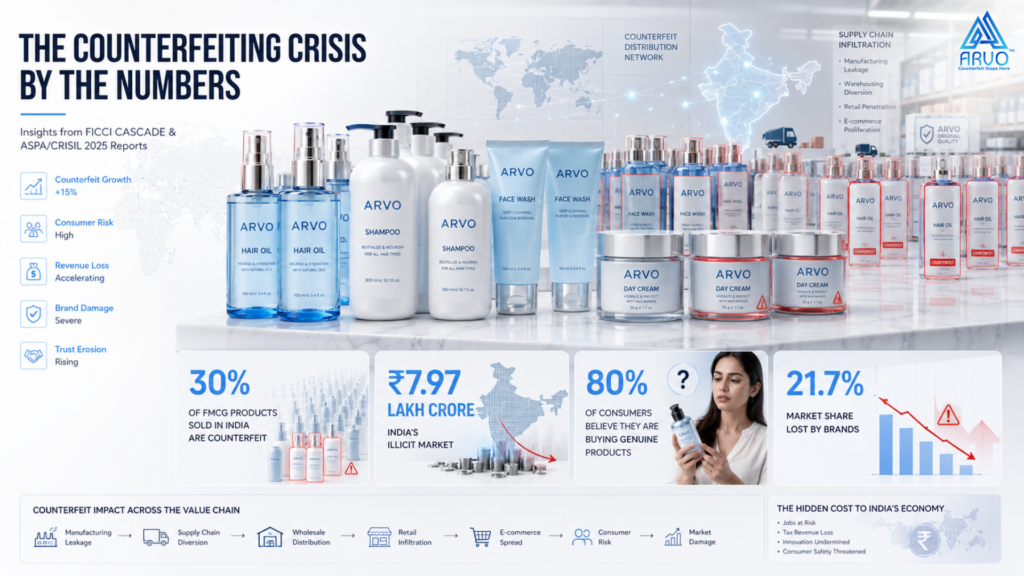
The headline figure is stark: the total illicit market across five key Indian industries has been estimated at ₹7,97,726 Crore (approximately ₹7.97 Lakh Crore). Within this, FMCG Packaged Foods accounts for ₹2,23,875 Crore and FMCG Personal and Household Care Goods accounts for ₹73,813 Crore. Combined, FMCG categories represent nearly 37% of the total illicit market value in India.
FICCI CASCADE further reports that FMCG companies are losing 21.7% of their total market share to counterfeit products. The highest revenue loss is concentrated in FMCG packaged and personal goods, estimated at ₹35,413 Crore. The tax revenue loss to the government exchequer from illicit markets across seven manufacturing sectors stands at ₹1,05,381 Crore.
Perhaps most critically for beauty manufacturers, the counterfeit FMCG market is growing at 15% annually, which is faster than the growth rate of the legitimate FMCG market itself. This means counterfeiters are not merely capturing a static share of the market. They are expanding their share. Every year that passes without authentication deployment, the counterfeiting problem grows larger, more sophisticated, and more expensive to combat.
The ASPA/CRISIL 2025 Report: What Indian Consumers Are Actually Experiencing
The “State of Counterfeiting in India 2025” report, released by the Authentication Solution Providers’ Association (ASPA) in collaboration with CRISIL Intelligence, provides the consumer-facing dimension that complements the FICCI industry data.
The report found that 35% of urban Indians encountered counterfeit products in the past year. Consumers themselves estimated that approximately 29% of products in their local markets are counterfeit. In the FMCG category specifically, 27% of consumers reported encountering fake products within the preceding 12 months.
ASPA’s counterfeit news repository recorded 187 instances of FMCG counterfeiting in 2025 alone, bringing the cumulative total of documented cases between 2018 and 2025 to 1,022. This represents a 2.5-fold increase in counterfeiting incidents over seven years. The growth is not linear. It is accelerating.
On the economic side, counterfeit FMCG products are sold at approximately 19% below the price of genuine products, creating a price-based incentive for unsuspecting consumers. However, the same survey revealed that consumers are willing to pay an average 9% premium for guaranteed genuine FMCG products. This is a critical insight for beauty manufacturers. There is measurable consumer demand for authenticity verification. Brands that provide it through secure QR codes for beauty products are not adding cost. They are capturing a premium that consumers are actively willing to pay.
Category-Wise Breakdown: Which Beauty Products Are Most Targeted by Counterfeiters
According to ASPA President Nakul Pasricha and corroborated by enforcement data across multiple Indian states, the beauty and personal care products most frequently targeted by counterfeiters in India are, in order of prevalence: hair oil, shampoo, cream, and face wash.
Hair oil is the single most counterfeited beauty category in India. Enforcement investigations have found counterfeit hair oils diluted with cheap industrial alternatives, and in some cases containing adhesive substances. The combination of high consumer demand, simple liquid formulation, and straightforward packaging makes hair oil the most accessible entry point for counterfeiters.
Shampoo follows closely. Counterfeit shampoos have been found with chemical compositions that bear no resemblance to the genuine formulation, causing scalp irritation, hair damage, and in severe cases, permanent hair loss. Fake creams, particularly skin whitening and fairness creams, have been found to contain mercury and lead-based compounds. Mercury is a neurotoxin. Lead causes cumulative neurological damage. These are not theoretical risks. These are substances that enforcement agencies have documented in seized counterfeit products across Mumbai, Delhi, and multiple Tier 2 cities.
Face wash completes the most-targeted list. The relatively simple manufacturing process and universal consumer demand make face wash an attractive target for counterfeiters operating at any scale, from single-room operations to industrial-level manufacturing units.
The 80% Awareness Gap: Why Consumers Cannot Protect Themselves
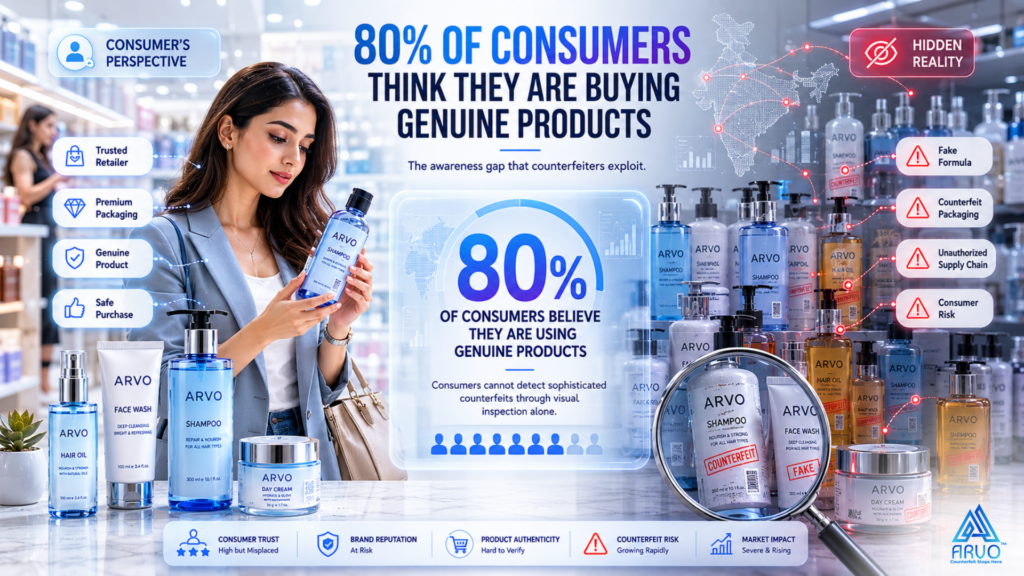
FICCI CASCADE’s data reveals what is perhaps the most dangerous statistic in the entire counterfeiting landscape: 30% of FMCG products sold in India are fake, but 80% of consumers believe they are using genuine products. This 50-percentage-point gap between reality and consumer perception is the single greatest vulnerability that counterfeiters exploit.
Consumers cannot detect sophisticated counterfeits through visual inspection alone. The packaging looks identical. The branding is replicated with increasing precision. The retail environment, whether a trusted kirana store or a verified marketplace listing, provides a false sense of security. ASPA has documented counterfeiters collecting genuine discarded packaging and refilling it with fake products, making even packaging authenticity an unreliable indicator.
This awareness gap means that the responsibility for protecting consumers from counterfeits cannot rest with the consumers themselves. It rests with the manufacturer. The only way to close the gap between the 30% counterfeiting rate and the 80% consumer confidence rate is to give consumers a technology-driven verification mechanism that eliminates subjective judgement entirely. This is where secure QR codes for beauty products become not just a brand protection tool but a consumer safety imperative.
What the Enforcement Data Confirms on the Ground
The FICCI and ASPA data is corroborated by a sustained pattern of enforcement operations across Indian cities over the past 18 months.
The Directorate of Revenue Intelligence (DRI) in Mumbai seized counterfeit cosmetics worth ₹6.5 Crore in a single July 2025 operation. The Maharashtra FDA seized ₹2.5 Crore in fake beauty products from South Mumbai, with laboratory analysis confirming mercury and lead compounds. In Thane, a warehouse connected to e-commerce fulfilment yielded ₹88 Lakh in seized cosmetics. In Delhi, a factory mass-producing counterfeit beauty products for national distribution was dismantled. The DCGI conducted nationwide raids across 30 locations and recovered ₹4 Crore in non-BIS-compliant products, including stem cell serums and unregistered glutathione injections sold as cosmetic items.
In April 2026, FICCI CASCADE organised an interactive session in Goa on combating illicit trade, where a new KPMG study covering eight sectors including FMCG and luxury goods was previewed, scheduled for release at MASCRADE in September 2026. In June 2026, FICCI CASCADE is conducting a capacity-building programme for police officers in Punjab on tackling counterfeiting and smuggling. The government’s enforcement apparatus is scaling. But enforcement alone cannot match the 15% annual growth rate of the counterfeit market.
For beauty manufacturers, the message from the enforcement data is clear. Regulatory action is necessary but insufficient. Protection must be embedded at the product level, at the manufacturing stage, and must travel with the product through every distribution channel to the consumer’s hands.
How ARVO Protects Beauty Brands with Secure QR Codes and End-to-End Authentication
ARVO provides a complete anti counterfeiting solution India beauty ecosystem that addresses every vulnerability identified in the FICCI and ASPA data. The system deploys in 7 days, costs a few paise per unit, delivers 99.97% authentication accuracy, and requires no app download for consumer verification.
Copy-Proof Nova Codes for Unit-Level Authentication
At the foundation of ARVO’s solution are Nova codes: copy-proof QR codes powered by Cryptographic Data Pattern (CDP) encryption. Every individual product unit receives a mathematically unique digital fingerprint that cannot be cloned, copied, photographed, or mass-reproduced. When a consumer scans a Nova code with their smartphone camera, the product is verified against ARVO’s secure cloud database and an instant result is delivered: authenticated or unverified. This is the technology that closes the 80% awareness gap. Consumers no longer need to guess whether a product is genuine. The Nova code provides a definitive answer in seconds.
Complete Supply Chain Visibility with Every Scan
Every time a Nova code is scanned, the system captures the geographic location, timestamp, verification result, and device data. This intelligence flows in real time to the manufacturer’s dashboard. For the first time, beauty brands gain visibility into where their products are actually being consumed, not just where they are shipped. Products scanned in locations inconsistent with their assigned distribution are flagged instantly. Grey market diversion, which costs the industry over ₹1,000 Crore annually, becomes detectable and actionable.
AI-Powered Consumer Engagement and Loyalty
Once a product is verified as authentic, ARVO activates an AI-powered chat interface trained on the manufacturer’s product knowledge. The consumer can ask questions about ingredients, receive personalised skincare or haircare routines, explore product origin and sourcing details, and interact with the brand in a conversational format. This transforms every scan from a security checkpoint into a premium brand experience. The AI chat also supports loyalty programme integration, allowing consumers to earn rewards, access exclusive content, and receive personalised recommendations based on their engagement history.
The AIC Dashboard: Centralised Brand Intelligence
All data from Nova code scans, supply chain tracking, AI chat interactions, and consumer engagement flows into the AIC (ARVO Integrated Cloud) dashboard. This centralised command centre provides geographic scan heatmaps across Indian cities, counterfeit alert systems with instant email and SMS notifications, grey market detection analytics comparing distribution records against scan locations, consumer engagement metrics from AI chat interactions, and loyalty programme participation data. Every scan is a data point. Every data point is actionable intelligence that informs manufacturing planning, distribution strategy, and marketing investment.
Frequently Asked Questions
What does the FICCI 30% statistic mean specifically for beauty and cosmetics manufacturers?
FICCI CASCADE reports that 30% of all FMCG products sold in India are counterfeit. ASPA confirms that hair oil, shampoo, cream, and face wash are among the most frequently counterfeited product categories. This means beauty manufacturers are losing a proportional share of their market to fakes. FICCI further estimates that FMCG companies lose 21.7% of total market share to counterfeit goods. For a beauty brand with ₹100 Crore in annual revenue, this translates to approximately ₹21 Crore in revenue captured by counterfeiters. Deploying secure QR codes for beauty products with copy-proof authentication directly protects this revenue.
How do secure QR codes differ from the standard QR codes already printed on many beauty products?
Standard QR codes encode a simple URL and provide zero security. Any counterfeiter can photograph and reproduce a standard QR code using a basic printer. ARVO’s Nova codes use Cryptographic Data Pattern (CDP) encryption to generate a mathematically unique digital fingerprint for every individual unit. This fingerprint is embedded at a level that is invisible to the human eye but verifiable through algorithmic scanning. Nova codes cannot be cloned, copied, or mass-produced. The authentication accuracy is 99.97%.
Can the system detect grey market diversion in addition to counterfeiting?
Yes. ARVO’s supply chain visibility module captures the geographic location of every scan. When a product assigned to a distributor in one city is scanned in a different city, the system flags the anomaly automatically. This enables manufacturers to identify which distributors are diverting stock to unauthorised channels. Grey market detection is built into the same infrastructure as counterfeit detection, requiring no additional deployment or cost.
What consumer engagement features does ARVO provide beyond authentication?
After a product is verified as authentic, ARVO activates an AI-powered chat widget trained on the manufacturer’s product data. Consumers can ask questions about ingredients, receive personalised usage routines, explore product origin and sourcing transparency, and interact with the brand conversationally. The system also supports loyalty programme integration where consumers earn rewards for scanning and engaging. All interaction data flows into the AIC dashboard, giving the manufacturer direct consumer intelligence that bypasses every intermediary in the distribution chain.
How quickly can the system be deployed, and does it require production changes?
ARVO’s complete system deploys in 7 days. Day 1 to 2 covers brand onboarding and AI chat configuration. Day 2 to 4 covers label design and integration with existing packaging equipment. Day 4 to 6 covers the first serialised production run with blockchain records. Day 7 is go-live for consumer verification. No production downtime is required. No packaging redesign is needed. No new capital equipment is procured. The system integrates with your existing manufacturing infrastructure and is purely additive to your current workflow.
Protect Your Beauty Brand Against the 30% Counterfeiting Rate
The FICCI data is unambiguous. 30% of the market is fake. 80% of consumers cannot tell the difference. The counterfeit market is growing at 15% annually. And your brand is losing revenue, trust, and market share every day that your products ship without authentication.
ARVO delivers the complete protection ecosystem for Indian beauty manufacturers: copy-proof Nova codes for unit-level authentication, real-time supply chain visibility with every scan, AI-powered consumer engagement with loyalty integration, and the AIC dashboard for centralised brand intelligence. Deployed in 7 days. A few paise per unit. 99.97% accuracy. No app required.
Download ARVO’s India Beauty Brand Protection Guide: