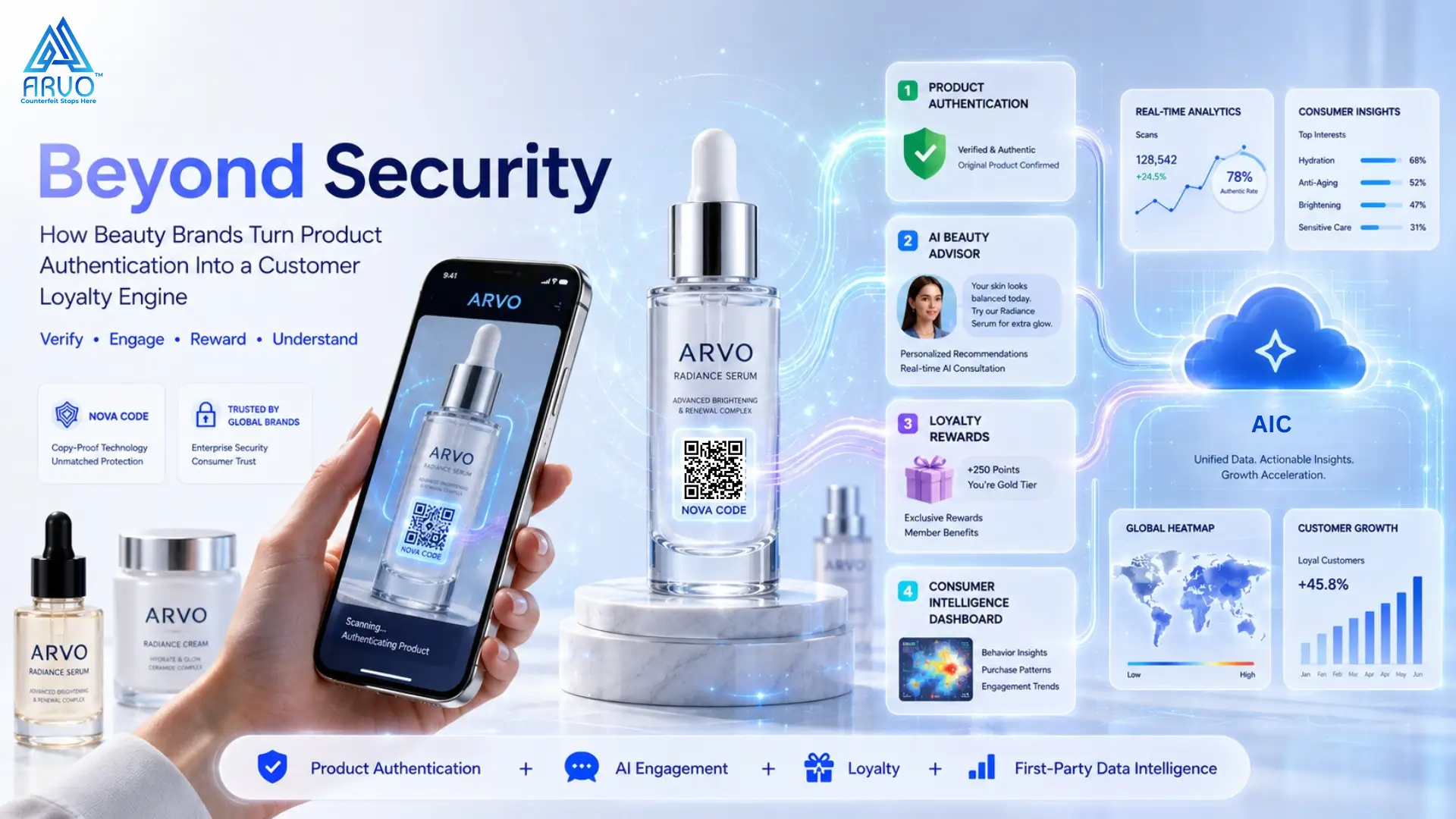
Most beauty manufacturers in India think of product authentication as a cost centre. A security expense. A compliance line item. They deploy it to stop counterfeiters, satisfy regulators, and protect revenue from the ₹8,000 Crore in annual losses that counterfeiting, marketplace fakes, and grey market diversion inflict on the Indian beauty industry.
But authentication is not just a shield. It is a channel. Every time a consumer scans a product, they are raising their hand and saying: I own your product, I am using it right now, and I am willing to engage with your brand. In 2025, 59% of consumers globally scan QR codes daily. 61% actively engage with QR-powered loyalty programmes. 95% of businesses using QR codes report that they gather valuable first-party data through every scan. And 59% of consumers now expect brands to use QR codes for transparency around ingredients, sourcing, and product origin.
For Indian beauty manufacturers, this means the beauty brand protection India strategy is not a binary choice between security and engagement. It is a convergence. The same technology that verifies a product’s authenticity can simultaneously drive loyalty, capture first-party consumer data, deliver personalized brand experiences, and build the kind of direct manufacturer-to-consumer relationship that no distributor report or marketplace dashboard can replicate.
This article is written for CMOs, Marketing Directors, and brand leaders in Indian beauty companies. It presents a framework for transforming authentication from a defensive cost into an offensive growth asset.
Table of Contents
The 80% Trust Gap: Why Authentication Is a Marketing Problem
FICCI reports that 30% of FMCG products sold in India are counterfeit. The ASPA/CRISIL 2025 report found that 89% of urban Indian consumers have purchased a counterfeit product at least once in their lifetime. And yet, 80% of consumers believe they are using genuine products. This 50-percentage-point gap between perception and reality is not a security problem alone. It is a brand trust problem. And brand trust is a marketing responsibility.
When a consumer purchases what they believe is your premium face serum and the results are poor because the product is counterfeit, they do not investigate the supply chain. They conclude that your brand overpromises and underdelivers. They post a negative review. They tell their social circle. They switch to a competitor. The revenue loss from that counterfeit sale is quantifiable. The lifetime value loss from that consumer’s permanent brand abandonment is exponentially greater.
But here is the insight that most beauty brand marketing teams have not yet internalised: the ASPA/CRISIL 2025 report also found that consumers are willing to pay an average 9% premium for guaranteed genuine FMCG products. There is measurable, documented consumer demand for authenticity verification. Brands that provide it are not adding cost. They are capturing a premium that Indian consumers are actively willing to pay. Authentication is not a defensive expense. It is a revenue-generating brand trust mechanism.
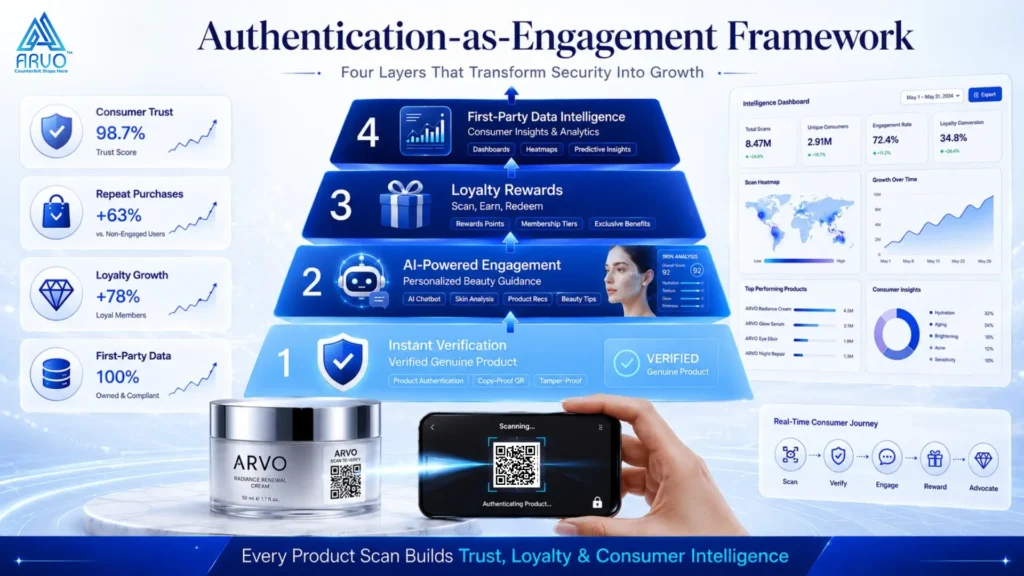
The Authentication-as-Engagement Framework: Four Layers That Transform a Security Tool Into a Growth Engine
Traditional beauty brand protection in India approaches treat authentication as a one-dimensional function: scan, verify, done. The consumer confirms the product is genuine, and the interaction ends. This approach captures approximately 5% of the value that authentication technology can deliver. The remaining 95% is left on the table.
The authentication-as-engagement framework operates across four layers, each building on the previous one. Layer 1 is instant verification that builds consumer confidence. Layer 2 is AI-powered post-scan engagement that creates a brand experience. Layer 3 is a scan-based loyalty programme integration that drives repeat purchases. Layer 4 is first-party data intelligence that informs every marketing decision. When all four layers are active, every product scan becomes a consumer touchpoint that simultaneously protects the brand, engages the customer, builds loyalty, and generates intelligence.
Layer 1: Instant Verification That Builds Consumer Confidence
The foundation layer is the verification experience itself. When a consumer scans a copy-proof QR code on your product and sees an instant, unambiguous result confirming the product as genuine, something shifts in their relationship with the brand. The scan is not just a security check. It is a brand promise, delivered and verified in real time.
In 2025, 59% of consumers globally scan QR codes daily. 43% scan specifically to access product information. Indian consumers are among the most active QR code users in the world, with 77% of Indian consumers reporting active QR code usage in a 2022 YouGov survey. The behaviour is established. The infrastructure is in the consumer’s hands. The only missing piece is a verification experience on your product that converts that scan into a trust moment.
For semi-luxury beauty products, where the price premium is justified by quality and brand credibility, verification transforms an abstract brand promise into a tangible, scannable proof point. Every verified scan reinforces the consumer’s decision to purchase. Every verified scan differentiates your brand from competitors who offer no verification mechanism. In a market where 35% of urban Indians encountered counterfeits in the past year, the brand that provides instant verification wins trust that competitors without it cannot match.
Layer 2: AI-Powered Post-Scan Engagement That Creates a Premium Brand Experience
Layer 1 confirms authenticity. Layer 2 extends the interaction. After verification, the consumer enters an AI-powered engagement interface that is trained on your brand’s specific product knowledge. This is not a static FAQ page. It is a conversational, personalised experience that delivers the kind of one-to-one guidance traditionally reserved for flagship store beauty consultations.
The consumer can ask about ingredient benefits, receive personalised skincare or haircare routines based on their concerns, explore product origin and sourcing transparency, learn application techniques, and discover complementary products within your portfolio. Every interaction feels like a personal beauty consultation, delivered through the product packaging itself.
The data supports this approach. Research shows that 39% of consumers now expect personalised experiences when scanning QR codes. 88% of marketers report that consumer sentiment toward QR codes has become more positive in 2025. And the most effective content that drives QR scans is exclusive content or information (39% of marketers) followed by discounts and promotional offers (33%). Beauty products authentication combined with AI-powered engagement delivers exactly this: exclusive, personalised, brand-specific content that the consumer cannot access any other way.
Layer 3: Scan-Based Loyalty Programme Integration
Layer 3 converts engagement into retention. 61% of consumers globally engage with QR-powered loyalty programmes. 33% of marketers already link QR codes to loyalty programmes as a primary use case. The scan-based loyalty model for beauty products works by rewarding consumers for the actions they are already taking: scanning, verifying, and engaging with the product.
The mechanics are simple. Every time a consumer scans a product, they earn points. Every AI chat interaction contributes to their loyalty score. Repeat purchases of different products within the brand portfolio are rewarded with bonus multipliers. Tier-based rewards (Silver, Gold, Premium) create aspirational progression that mirrors the premium positioning of the brand itself.
For Indian beauty brands, scan-based loyalty solves three persistent marketing challenges simultaneously. First, it incentivises repeat purchases through a reward mechanism that is embedded in the product, not dependent on a separate app or card. Second, it creates an ongoing engagement loop where each product purchase deepens the consumer’s relationship with the brand. Third, it generates verifiable purchase data that confirms actual product usage, not just transaction records from distributors.
The business impact is direct. Authentication-driven loyalty programmes reduce the cost of customer retention by embedding loyalty into the product itself. The consumer does not need to remember a loyalty card, download a separate app, or register on a website. The product is the loyalty programme. The scan is the earning mechanism. The engagement is the reward.
Layer 4: First-Party Data Intelligence That Transforms Marketing Decisions
In 2025, 95% of businesses using QR codes report gathering valuable first-party data through scans. As third-party cookies phase out and privacy regulations tighten, first-party data has become the most valuable asset in any marketing organisation’s arsenal. Authentication scans generate this data at scale, directly from your consumers, with their consent, through an interaction they initiated voluntarily.
Every product scan generates a data point: geographic location, timestamp, device type, verification result, scan frequency, AI chat questions asked, loyalty actions taken, and product preferences expressed. Aggregated across thousands of scans, this data reveals patterns that no traditional marketing research can match.
Geographic scan heatmaps reveal where your products are actually being used, not just where they are shipped. Scan frequency data shows which SKUs generate the highest consumer engagement. AI chat question patterns reveal what consumers care about most: ingredients, usage guidance, sourcing transparency, or competitor comparisons. Verification failure clusters identify markets where counterfeit activity is concentrated. And loyalty progression data shows which consumers are most engaged and most valuable.
For CMOs and Marketing Directors, this intelligence transforms beauty brand protection in India from a security budget line into a marketing intelligence platform. Media spend can be optimised based on actual consumer engagement geography. New product development can be informed by real AI chat data showing what consumers are asking for. The distribution strategy can be adjusted based on scan patterns that reveal actual consumption versus reported sales.
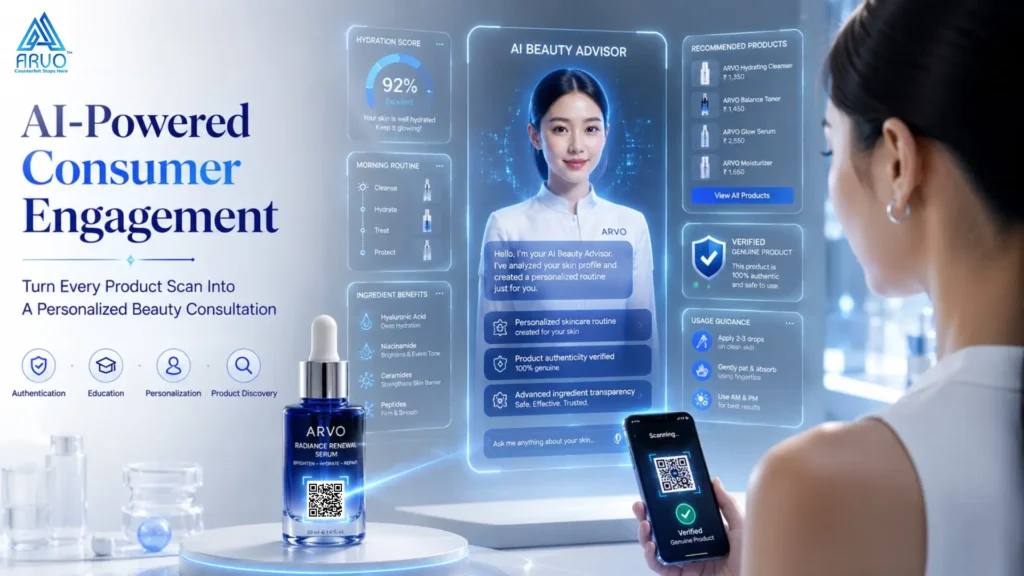
How ARVO Delivers Authentication Plus Engagement in One Ecosystem
ARVO’s anti-counterfeiting solution for India’s beauty platform is built on the authentication-as-engagement framework from the ground up. Every component, from the copy-proof Nova code on the product to the AIC dashboard on the leadership team’s screen, is designed to deliver security, engagement, loyalty, and intelligence simultaneously.
Copy-Proof Nova Codes: The Verification Layer
Nova codes use Cryptographic Data Pattern (CDP) encryption to generate a unique digital fingerprint for every product unit. Authentication accuracy is 99.97%. Verification is browser-based with no app download required. The consumer scans, verifies, and the trust moment is delivered in seconds.
AI-Powered Consumer Chat: The Engagement Layer
After verification, ARVO activates an AI chat interface trained on your product knowledge. Consumers receive personalised routines, ingredient transparency, usage guidance, and brand storytelling. Every chat interaction deepens the brand relationship and generates engagement data.
Integrated Loyalty Programme: The Retention Layer
ARVO’s system supports scan-based loyalty integration. Consumers earn rewards for scanning, engaging, and repurchasing. Tier-based progression creates aspirational engagement. The product itself becomes the loyalty mechanism. No separate app, card, or registration required.
Supply Chain Visibility: The Protection Layer
Every scan captures geographic location, timestamp, and verification data in real time. Grey market diversion is detected through geographic anomaly alerts. Counterfeit infiltration is flagged through verification failure clustering. Products are traceable from the manufacturing floor to consumers’ hands.
The AIC Dashboard: The Intelligence Layer
The AIC (ARVO Integrated Cloud) dashboard consolidates every data stream into a single command centre for marketing, operations, and leadership teams. Geographic scan heatmaps, consumer engagement metrics, loyalty programme analytics, counterfeit alerts, grey market detection, and AI chat interaction data are all accessible in real time. Every scan is a data point. Every data point informs a smarter marketing decision.
The complete system deploys in 7 days. The per-unit cost is a few paise. No production downtime. No packaging redesign. No app development.
Frequently Asked Questions
How does authentication create customer loyalty rather than just preventing counterfeiting?
Authentication creates a direct, product-level interaction between the brand and the consumer. When a consumer scans a product and receives instant verification followed by personalised AI engagement and loyalty rewards, the scan transforms from a security check into a brand experience. 61% of consumers engage with QR-powered loyalty programmes globally. The scan-based model embeds loyalty into the product itself: every verification earns points, every AI chat interaction deepens engagement, and every repeat purchase is rewarded. This creates a retention loop that traditional loyalty cards and separate apps cannot match.
What kind of first-party data does the authentication system generate for marketing teams?
Every product scan generates geographic location data, timestamps, device information, verification results, scan frequency per consumer, AI chat questions and interaction patterns, loyalty programme participation, and product preferences. Aggregated across thousands of scans, this data reveals which markets have the highest engagement, which SKUs generate the most consumer interaction, what questions consumers ask most frequently, where counterfeit or grey market activity is concentrated, and which consumers are most valuable based on scan and loyalty behaviour. This is permission-based, first-party data collected directly from consumers through an interaction they initiate voluntarily.
Does the loyalty programme require consumers to download a separate app?
No. ARVO’s verification and loyalty experience is entirely browser-based. When a consumer scans the Nova code on the product using their smartphone’s native camera, the verification, AI chat, and loyalty interface all open directly in the phone’s browser. No app download, no registration, and no account creation are required. This no-app approach is critical for the Indian market, where smartphone storage constraints and app fatigue significantly reduce adoption rates for app-dependent systems. The product is the loyalty programme. The scan is the earning mechanism.
How does this approach compare in cost to traditional loyalty programme infrastructure?
Traditional loyalty programmes require separate app development, maintenance, marketing to drive downloads, and ongoing platform costs. ARVO’s authentication-as-engagement model integrates loyalty directly into the product authentication flow, eliminating the need for a separate loyalty infrastructure. The per-unit cost is a few paise, and the loyalty, engagement, and intelligence capabilities are included within the same authentication investment. For brands that are already investing in anti-counterfeiting, the engagement and loyalty layers add no high incremental cost. They are inherent in the same technology.
Can the system be deployed alongside an existing CRM or loyalty platform?
Yes. ARVO’s AIC dashboard is designed to integrate with existing marketing and CRM systems through standard API connections. Scan data, loyalty events, and consumer engagement metrics can flow into your existing customer data platform, enriching CRM profiles with product-level, scan-level, and engagement-level data that traditional purchase data alone cannot provide. The system operates as an additive intelligence layer that enhances your existing marketing infrastructure rather than replacing it.
Authentication Plus Engagement Equals ARVO AIC
Every product scan is a consumer raising their hand. The question is whether your brand has the infrastructure to respond with verification, engagement, loyalty, and intelligence in a single interaction. ARVO provides that infrastructure.
Copy-proof Nova codes. AI-powered consumer engagement. Scan-based loyalty integration. Real-time supply chain visibility. The AIC dashboard for centralised brand intelligence. Deployed in 7 days. A few paise per unit. 99.97% authentication accuracy. No app required.