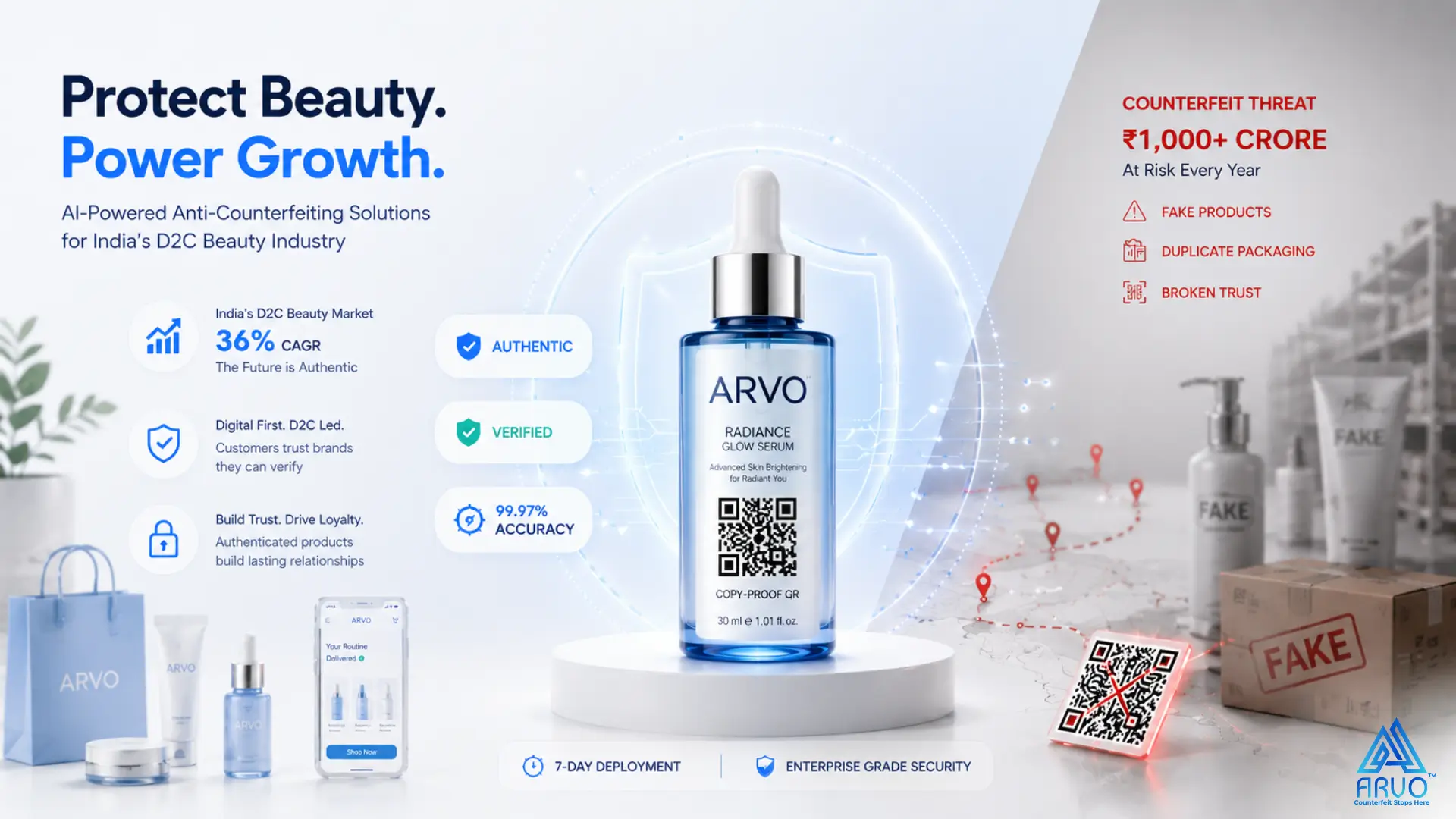
India’s D2C beauty and personal care market is one of the fastest-growing consumer segments anywhere in the world. The market is projected to grow at 36.4% to 36.6% CAGR from 2026 to 2033, with online-only D2C brands commanding 64.9% of the total market share. India now hosts over 800 active D2C beauty brands. Between 2014 and 2022, D2C beauty startups collectively raised over $5 billion in venture and growth funding. Beauty and personal care accounted for nearly 50% of all D2C investment inflows. The broader Indian D2C e-commerce market reached $87.5 billion in 2025 and is projected to hit $322.1 billion by 2031.
The growth story is extraordinary. But it has a shadow. The same digital infrastructure that enables D2C brands to reach millions of consumers has also enabled counterfeiters to reach those consumers first. FICCI reports that 30% of all FMCG products sold in India are counterfeit. The ASPA/CRISIL 2025 report found that 89% of urban Indian consumers have purchased a counterfeit product at least once. Online aggregator platforms account for 53% of all counterfeit purchases. And the counterfeit FMCG market in India is growing at 15% annually. For D2C beauty founders, the mathematics are unforgiving: your brand is scaling at 36% CAGR, but counterfeiting is scaling alongside it.
This article is written for D2C beauty founders, co-founders, and leadership teams. It examines the specific vulnerabilities of the D2C model, quantifies the cost of inaction, and presents a complete D2C brand anti-counterfeiting India framework that can be deployed in 7 days for a few paise per unit.
Table of Contents
The D2C Beauty Boom: Growth Numbers That Attract Counterfeiters
The Indian D2C beauty market’s growth trajectory is creating the precise conditions that counterfeiters exploit. To understand why D2C brands are disproportionately targeted, it is necessary to examine the numbers through the counterfeiter’s lens.
The D2C beauty market is growing at 36.4% CAGR. This means consumer demand is accelerating faster than most brands can build distribution infrastructure. Counterfeiters fill that gap. When a D2C serum goes viral on social media and the brand’s direct channels struggle to keep up with demand, counterfeit versions appear on marketplace listings within days. The demand signal is public (social media virality), the product is identifiable (packaging is photographed in unboxing videos), and the price point is high enough to justify the counterfeiting effort.
Online-only D2C brands hold 64.9% market share. This means the majority of D2C beauty products are sold through channels where physical verification before purchase is impossible. A consumer cannot touch, smell, or inspect a product purchased through an e-commerce listing or a quick commerce order. They rely entirely on the listing’s photographs, the seller’s reputation, and the platform’s assurance. Counterfeiters have mastered all three.
D2C brands raised over $5 billion in funding between 2014 and 2022. This level of investment drives aggressive growth, rapid SKU expansion, and multi-channel distribution at a pace that outstrips quality control and supply chain oversight. The faster a D2C brand scales, the more distribution touchpoints it creates, and the more entry points exist for counterfeit products. The paradox is that the very metrics investors reward, growth rate, channel expansion, and market penetration, are the same factors that increase counterfeiting vulnerability.
Quick Commerce and Social Commerce: The Two Channels Where D2C Brands Are Most Exposed
India’s quick commerce segment is projected to reach $5.38 billion in 2025, growing at 17% annually. Beauty is one of the fastest-growing categories on quick commerce platforms, with brands reporting 3x growth on these channels and 25% higher average selling prices compared to traditional e-commerce. But quick commerce’s speed creates a verification gap that counterfeiters exploit.
Quick commerce platforms onboard local suppliers and dark store inventory at speed. The sourcing verification processes that large FMCG companies have built over decades do not exist in the same form for D2C brands selling through quick commerce. A counterfeit product that enters a dark store’s inventory is delivered to a consumer’s doorstep within 10 to 20 minutes, with no opportunity for inspection at any point in the chain.
Social commerce presents an even more direct vulnerability. 71% of Indian beauty consumers discover products via social media. 37% of Indian consumers aged 15 to 24 purchased counterfeit products through social media recommendations in a 2022 survey. The ASPA/CRISIL 2025 report identifies social media advertisements as a rapidly growing counterfeit distribution channel. For D2C brands that build their entire acquisition strategy on social media and influencer marketing, the irony is severe: the channels you invest in to grow are the same channels counterfeiters use to sell fakes under your name.
When a D2C brand’s product goes viral through an influencer unboxing or a trending reel, counterfeiters can have replica listings live on marketplace and social commerce within 48 to 72 hours. The consumer sees a product that looks identical, priced 15% to 20% lower (ASPA data shows counterfeits are sold at approximately 19% below genuine price), and purchases without hesitation. The counterfeit arrives. The consumer uses it. The results are poor. And the negative review lands on the genuine brand’s reputation.
3 Critical Mistakes D2C Beauty Founders Make with Anti-Counterfeiting
Mistake 1: Treating Authentication as a Post-Scale Priority
The most common and most costly mistake is deferring authentication to a later stage of growth. The reasoning is understandable: in the early stages, D2C founders are focused on product-market fit, customer acquisition, and unit economics. Anti-counterfeiting feels like an enterprise-level concern. But counterfeiting does not wait for brands to reach scale. Counterfeiters target brands that are growing, because growth creates demand, and demand is what counterfeiters monetise. By the time a D2C founder discovers counterfeits in the market, the brand damage has already compounded through negative reviews, consumer complaints, and trust erosion that no marketing budget can efficiently reverse.
Mistake 2: Assuming That Standard QR Codes Provide Security
Many D2C brands print a QR code on their packaging and assume it provides authentication. A standard QR code is nothing more than a URL encoded into a pattern. Any counterfeiter can photograph it and reproduce it using a basic printer. Standard QR codes provide zero security. They are not authentication. They are decoration. Copy-proof QR codes with Cryptographic Data Pattern (CDP) encryption are the minimum standard for genuine product authentication. Every code must be mathematically unique at the unit level, non-reproducible, and verifiable against a secure database.
Mistake 3: Neglecting Online Marketplace and Social Commerce Monitoring
D2C brands that do not actively monitor their listings across marketplaces and social commerce channels are operating blind. Counterfeit listings can appear within days of a product launch. They can operate for weeks or months before detection. The DCGI has already directed major e-commerce platforms to remove unauthorised cosmetic listings, establishing regulatory precedent. But the responsibility for identifying and reporting counterfeit listings ultimately rests with the brand. If you are not monitoring, you are not detecting. And what you do not detect, you cannot stop.
The Authentication ROI Framework for D2C Beauty Brands
The economics of authentication for D2C beauty brands are unambiguous when examined against the cost of counterfeiting.
The cost of authentication is a few paise per unit. For a D2C brand producing tens of thousands of units monthly, the total annual authentication investment represents a fraction of what the brand spends on a single influencer campaign or a month of performance marketing. The per-unit cost typically represents less than 1% to 2% of the product’s retail price.
The cost of not authenticating is measured in crores. FICCI CASCADE estimates that FMCG companies lose 21.7% of total market share to counterfeit goods. For a D2C brand generating ₹10 Crore in annual revenue, this implies approximately ₹2.17 Crore captured by counterfeiters. The DRI’s July 2025 Mumbai seizure alone recovered ₹6.5 Crore in counterfeit cosmetics. The Maharashtra FDA seized ₹2.5 Crore in fake beauty products from South Mumbai. The DCGI’s nationwide operation recovered ₹4 Crore.
Beyond direct revenue loss, the indirect costs compound. Negative reviews from consumers who unknowingly purchased counterfeits. Customer service burden from product complaints that the brand never manufactured. Brand trust erosion that increases customer acquisition costs across all channels. Regulatory risk under the Cosmetics Amendment Rules 2025, which mandate stricter documentation and traceability. For D2C brands competing in a market with over 800 players, where consumer switching costs are low and social proof is decisive, a single wave of counterfeit-driven negative reviews can permanently alter the brand’s growth trajectory.
How ARVO Protects D2C Beauty Brands from Day One
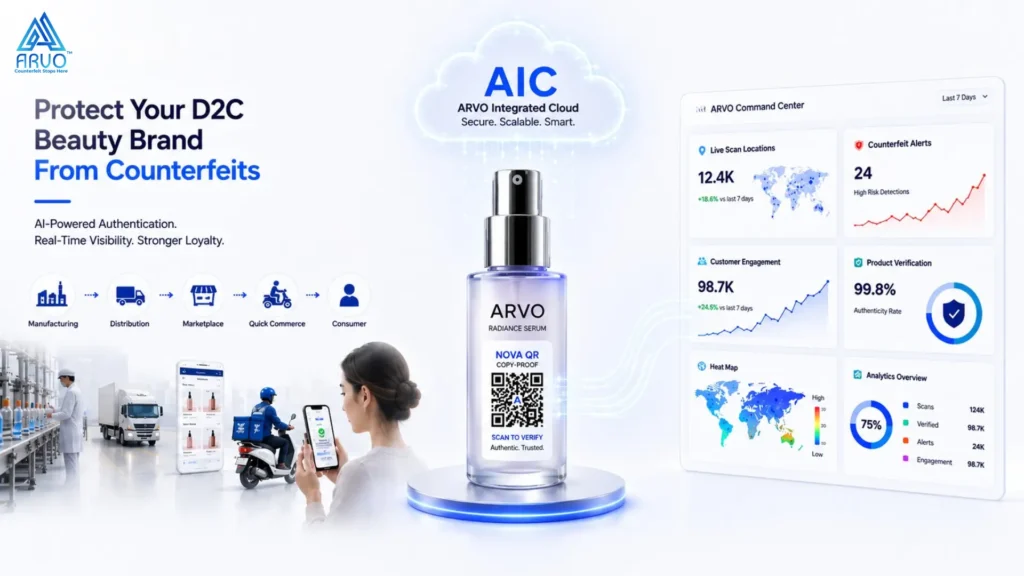
ARVO’s anti counterfeiting solution India beauty ecosystem is designed specifically for the speed, scale, and channel complexity of D2C beauty brands. The system deploys in 7 days, costs a few paise per unit, delivers 99.97% authentication accuracy, and requires no app download for consumer verification.
Copy-Proof Nova Codes for Unit-Level Authentication
Every product unit receives a Nova code with Cryptographic Data Pattern (CDP) encryption, creating a mathematically unique digital fingerprint that cannot be cloned, photographed, or reproduced. When a consumer scans the code with their smartphone camera, the product is verified instantly through a browser-based interface. No app required. The verification experience is designed for the speed that D2C consumers expect: scan, verify, engage, all within seconds.
Complete Supply Chain Visibility Across Every Channel
Every Nova code scan captures geographic location, timestamp, and verification data in real time. For D2C brands selling through their own website, marketplaces, quick commerce, and social commerce simultaneously, this provides the first unified view of where products are actually being consumed across every channel. Products scanned in locations inconsistent with their distribution are flagged instantly. Grey market diversion is detected. Counterfeit seller patterns are identified through verification failure clustering.
AI-Powered Consumer Engagement with Loyalty Integration
After verification, ARVO activates an AI-powered chat interface trained on the brand’s product knowledge. The consumer receives personalised skincare routines, ingredient transparency, usage guidance, and product recommendations. The AI chat supports integrated loyalty programme functionality where every scan earns points, every interaction deepens engagement, and every repeat purchase is rewarded. For D2C brands where customer retention economics are critical, the scan-based loyalty model embeds retention directly into the product.
The AIC Dashboard for Founder-Level Intelligence
The AIC (ARVO Integrated Cloud) dashboard provides D2C founders and leadership teams with centralised intelligence: geographic scan heatmaps, counterfeit alert systems with instant notifications, grey market detection analytics, consumer engagement metrics from AI chat, loyalty programme data, and complete scan history at the unit level. Every scan is a data point. Every data point informs product decisions, channel strategy, and marketing investment.
7-Day Deployment: Decision to Live
Day 1 to 2: Brand onboarding and AI chat training. Day 2 to 4: Nova code label design and printer integration with existing packaging. Day 4 to 6: First serialised production run with blockchain records activated. Day 7: Consumer verification, AI chat, loyalty, and AIC dashboard go live. No production downtime. No packaging redesign. No capital equipment. 2x faster than industry standard.
Frequently Asked Questions
1. At what stage of growth should a D2C beauty brand implement authentication?
Day one. Counterfeiting does not wait for brands to scale. ASPA data shows that counterfeit listings appear within days of a product gaining social media traction. The cost of authentication is a few paise per unit. The cost of deferring it is measured in negative reviews, brand trust erosion, and revenue permanently lost to counterfeiters. Every D2C brand should deploy authentication as part of its launch infrastructure, not as a reactive measure after counterfeits are discovered.
2. How does authentication work for D2C brands selling through quick commerce platforms?
The authentication works at the product level, not the platform level. Every unit that leaves your manufacturing floor carries a Nova code. Regardless of whether the consumer purchased through your website, a marketplace, a quick commerce app, or a social media link, the code on the product provides the same instant verification. This is critical for D2C brands where a single product may be sold through five or six channels simultaneously. The Nova code travels with the product, not with the platform.
3. Can the system help identify which marketplace or social commerce sellers are distributing counterfeits?
Yes. Every scan captures geographic location, timestamp, and verification result. When verification failures cluster around products purchased from specific platforms, seller accounts, or geographic regions, the AIC dashboard flags the pattern and alerts the brand team. This enables targeted investigation and takedown actions against specific counterfeit sellers. The DCGI’s directive to major e-commerce platforms to remove unauthorised listings provides regulatory backing for these takedown requests.
4. How does the AI chat and loyalty integration help with D2C customer retention?
D2C brands typically invest 5x to 7x more to acquire a new customer than to retain an existing one. ARVO’s AI chat and loyalty integration embed retention directly into the product. Every scan earns loyalty points. Every AI chat interaction delivers personalised value. Every repeat purchase is rewarded through tier-based progression. The consumer does not need a separate app, card, or registration. The product is the loyalty programme. For D2C brands where LTV-to-CAC ratio determines profitability, scan-based loyalty is the most capital-efficient retention mechanism available.
5. What data does the AIC dashboard provide that D2C founders cannot get from marketplace analytics?
Marketplace analytics tell you what was sold and where. The AIC dashboard tells you what was used, where, and by whom. Geographic scan heatmaps reveal actual consumption geography versus reported sales geography. AI chat data reveals what consumers are asking about, what concerns they have, and what products they are requesting. Verification failure patterns reveal counterfeiting activity before it appears in complaint data. Loyalty metrics show which consumers are most engaged and most valuable. This is first-party, product-level intelligence that no marketplace or distributor report can replicate.
Protect Your D2C Beauty Brand from Day One
Your brand is growing at 36% CAGR. Counterfeiting is growing alongside it. The channels you invest in to drive growth are the same channels counterfeiters use to distribute fakes under your name. Every day without authentication is a day of compounding brand damage.
ARVO delivers complete D2C brand anti-counterfeiting India protection: copy-proof Nova codes, AI-powered consumer engagement with loyalty integration, real-time supply chain visibility, and the AIC dashboard for founder-level intelligence. Deployed in 7 days. A few paise per unit. 99.97% accuracy. No app required.
Protect your D2C beauty brand from Day 1. Schedule a consultation