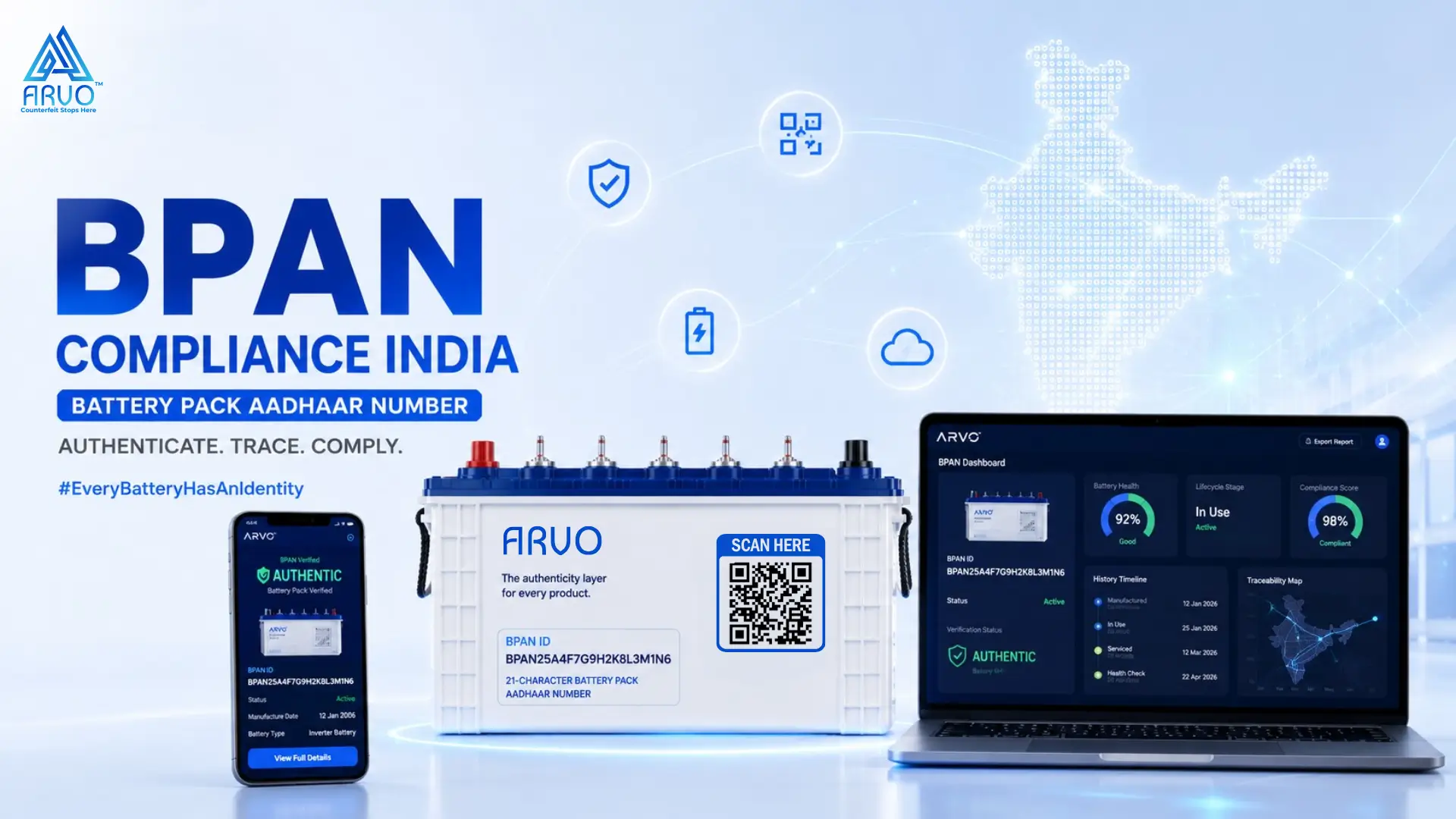
In January 2026, the Ministry of Road Transport and Highways (MoRTH) released draft guidelines for the implementation of the Battery Pack Aadhaar System. The framework introduces a mandatory digital identification mechanism that assigns a unique 21-character alphanumeric Battery Pack Aadhaar Number (BPAN) to every battery pack manufactured in or imported into India. The system is designed to ensure end-to-end lifecycle traceability of batteries, from raw material sourcing and manufacturing through usage, repurposing, recycling, and final disposal.
Source: MoRTH Draft Guidelines for Implementation of Battery Pack Aadhaar System, January 2026
For battery manufacturers and importers operating in India, BPAN compliance India is not a distant regulatory possibility. It is an active framework being institutionalized through the Automotive Industry Standard (AIS) route under the Automotive Industry Standards Committee (AISC). India’s lithium-ion battery market is valued at $6.73 billion in 2026 and is projected to reach $15.17 billion by 2031, growing at 17.65% CAGR. The EV battery pack segment alone is growing at 42.47% CAGR. Every manufacturer operating in this market will need to comply with BPAN.
Source: Mordor Intelligence, India Lithium-ion Battery Market 2026-2031; MarqStats, India EV Battery Pack Market 2026-2030
This guide provides a comprehensive analysis of what BPAN requires, how the 21-character code and QR system works, which battery categories are covered, what data must be captured and stored, and a step-by-step compliance roadmap that manufacturers can begin implementing immediately.
Table of Contents
What Is the Battery Pack Aadhaar Number (BPAN) and Why It Matters
The battery pack aadhaar number is a 21-character unique alphanumeric identification code assigned to every battery pack introduced in the Indian market. It functions as a digital identity for batteries, analogous to the Aadhaar identification system for Indian citizens. The BPAN is accompanied by a QR code that stores additional technical data, and a server-based dynamic data layer that records operational history throughout the battery’s lifecycle.
Source: PSA.gov.in, Battery Pack Aadhaar Guideline, 49-page document
The system was developed by a committee constituted by MoRTH in September 2025 and documented in a 49-page guideline published by the Principal Scientific Adviser to the Government of India. The framework is described as a “common digital spine” that different regulatory workstreams can reference, reducing duplication of data capture across agencies and stakeholders, improving auditability, supporting enforcement under Extended Producer Responsibility (EPR) and Battery Waste Management (BWM) rules, and enabling harmonisation with global standards where required.
Source: The Policy Edge, Guidelines for Battery Pack Aadhaar: How India Plans to Track EV Batteries, January 12, 2026
The strategic importance of BPAN extends beyond compliance. It supports the government’s Production Linked Incentive (PLI) scheme for Advanced Chemistry Cells (ACC), which has committed ₹18,100 Crore to 11 cell makers. It aligns with the Battery Waste Management Rules, 2022. It enables standardised valuation of used batteries, which is essential for financing second-hand EVs and scaling the used vehicle market. And it positions India’s battery ecosystem for interoperability with the EU Battery Regulation 2023, which mandates digital passports for EV and industrial batteries by 2027.
Source: MarketsandMarkets, India Li-ion Battery Market 2025-2030; Deccan Herald, A Green Mobility Push Through Battery Aadhaar
The 21-Character BPAN Code Structure Explained
Every BPAN consists of 21 characters divided into structured sections, each encoding specific information about the battery pack. Understanding this structure is essential for BPAN compliance India because manufacturers are responsible for generating the code correctly and permanently affixing it to every battery pack.
Characters 1 to 5: Battery Manufacturer Identifier (BMI)
The first five characters identify the country and manufacturer. The first two characters represent the region where the manufacturer is located. The remaining three characters represent the manufacturer itself. The BMI is pre-assigned by the national organisation designated in the guidelines.
Source: PSA.gov.in BPAN Guideline, Table 3: BMI Parameters
Characters 6 to 21: Battery Specifications and Unique Serial
The remaining 16 characters encode the battery’s technical specifications, including chemistry type (NMC, LFP, NCA), nominal capacity, cell origin country, manufacturing date, and a unique serial number. A pilot example in the draft guidelines illustrates a BPAN code decoding to a 30 kWh NMC battery manufactured in India with Korean-origin cells, dated April 17, 2025, with a carbon footprint of 10 kgCO2e/kWh.
Source: SRM Technologies, BPAN: The Backbone of India’s Evolving Battery Ecosystem, March 2026
The BPAN must be physically marked on the battery pack in a clearly visible and accessible location, chosen in a way that prevents damage, deterioration, or removal. A new BPAN must be generated whenever a battery is recycled, repurposed, or materially altered. This ensures that the digital identity accurately reflects the battery’s current state at every stage of its lifecycle.
Source: MobilityNotes, The Battery Pack Aadhaar Guideline Issued by Government of India, January 25, 2026
The 3-Tier Data Architecture: What Battery Manufacturers Must Capture
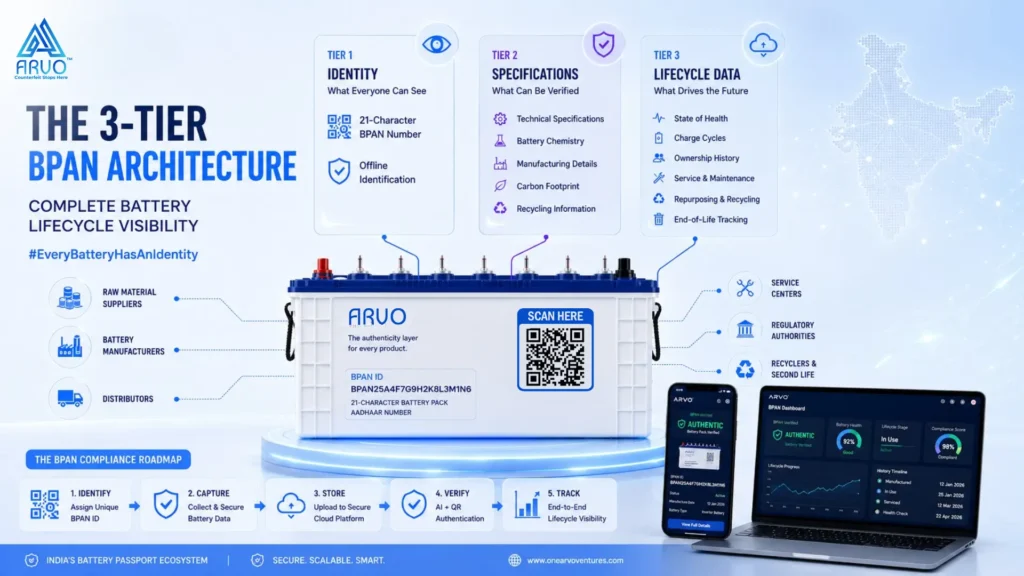
The BPAN system organises battery data into three distinct access tiers. Each tier serves a different purpose and carries different access permissions. Understanding this architecture is fundamental to battery traceability India compliance.
Tier 1: Alphanumeric Code (Public Access, Offline)
The 21-character code physically marked on the battery provides publicly accessible, offline identification. Any authorised user can read the code without system access to identify the country of origin, manufacturer, and basic battery specifications. This tier is designed for field-level identification by inspection authorities, customs officials, and first responders.
Tier 2: QR Code (Authorised Access, Offline)
The QR code linked to the BPAN stores static technical data accessible to authorised stakeholders. This includes detailed material composition (cathode chemistry, anode type, electrolyte), technical specifications (nominal voltage, capacity, energy density), carbon footprint parameters, and recycling information (disassembly methods, hazardous materials, material recovery data). This tier is particularly critical for recyclers, as it provides the information needed for optimal material recovery and safe disassembly.
Source: CoEZET, IIT Madras, Battery Pack Aadhaar System Platform Documentation
Tier 3: Server-Based Dynamic Data (Restricted Access, Online)
The third tier stores dynamic operational data that is updated throughout the battery’s lifecycle. This includes State of Health (SoH), charge and discharge cycle count, thermal events and safety incidents, ownership transfer records, maintenance and service history, and recycling or disposal outcomes. Access to this tier is restricted to authorised stakeholders including manufacturers, vehicle OEMs, regulators, and certified recyclers.
Source: Global South Policy Review, Government Issues Draft Battery Pack Aadhaar Guidelines for EV Traceability, 2026
Which Batteries Are Covered: Phase 1 and Phase 2 Scope
The BPAN framework is being implemented in two phases, reflecting the prioritisation of the battery segments with the greatest market impact and safety considerations.
Phase 1: Electric Vehicle Batteries (Priority)
EV batteries used in L category (two-wheelers and three-wheelers), M category (passenger vehicles), and N category (goods vehicles) are covered in the first phase. This prioritisation is based on the fact that EV batteries account for approximately 80% to 90% of India’s total lithium-ion battery demand. The India EV battery pack market is valued at $2.78 billion in 2025 and is projected to reach $16.32 billion by 2030, growing at 42.47% CAGR.
Source: MarqStats, India EV Battery Pack Market 2026-2030; InsightsOnIndia, Battery Pack Aadhaar Number, January 5, 2026
Phase 2: Industrial Batteries Above 2 kWh
Industrial batteries with a capacity exceeding 2 kilowatt-hours are recommended for inclusion in the second phase. This covers energy storage systems, telecom tower batteries, UPS systems, and industrial power applications. Portable batteries and SLI (Starting, Lighting, Ignition) batteries are currently excluded from the BPAN framework.
Source: Global South Policy Review; The Policy Edge BPAN analysis
Stakeholder Responsibilities Under BPAN
The BPAN framework assigns specific responsibilities to every entity in the battery value chain. Understanding these obligations is critical for compliance planning.
Battery Producers and Importers
Producers and importers carry the primary compliance burden. They must generate and assign the BPAN for every eligible battery pack, physically label the battery with the BPAN code and QR code, upload and maintain lifecycle data on the official BPAN portal, and ensure upstream data availability from cell and material suppliers. Every battery introduced in the Indian market, including those used for self-consumption, must carry a BPAN.
Source: MoRTH Draft Guidelines; pv-magazine India, January 5, 2026
Cell and Material Suppliers
Upstream suppliers must provide accurate technical and material data to support BPAN generation by the battery producer. This includes cell chemistry specifications, raw material composition, and country of origin information.
Vehicle OEMs
Vehicle manufacturers must integrate BPANs into vehicle documentation and national databases. The BPAN becomes part of the vehicle’s digital record, linking the battery identity to the vehicle identity throughout the ownership lifecycle.
Service Providers and Recyclers
Service providers handling battery repairs or modifications must update the dynamic data on the BPAN portal. Recyclers must update recycling outcomes and material recovery data. A new BPAN must be generated if the battery is materially altered during servicing or repurposing.
Government Agency
The designated government agency oversees the central BPAN portal, allocates manufacturer codes (BMI), and conducts compliance audits. The agency has the authority to verify that manufacturers are generating BPANs correctly and maintaining data as required.
Source: MobilityNotes; The Policy Edge; EVTech.News, June 2026
Step-by-Step BPAN Compliance Roadmap for Battery Manufacturers
The following roadmap provides a practical, prioritised sequence of compliance actions for manufacturers seeking to achieve BPAN compliance India readiness ahead of formal enforcement.
Step 1: Register for Your Battery Manufacturer Identifier (BMI)
Obtain your 5-character BMI from the designated national organisation. This code is the foundation of every BPAN your facility generates. It identifies your country and manufacturing entity in the first five characters of every BPAN code.
Step 2: Map Your Battery Data Architecture
Audit your current data capture systems against the three tiers of BPAN data requirements. Identify gaps in static data (material composition, specifications, carbon footprint) and dynamic data (SoH tracking, charge cycle logging, thermal event recording). Determine which data is currently captured by your existing systems and which requires new instrumentation or process changes.
Step 3: Implement QR Code Infrastructure on Your Production Line
The BPAN mandates that every battery must carry both an alphanumeric code and a QR code. The QR code must encode static technical data accessible offline by authorised stakeholders. This is where the choice of QR technology is critical. Standard QR codes offer zero security. Any entity can photograph and reproduce a standard QR code. For a system designed to ensure lifecycle traceability and prevent fraud, copy-proof QR codes with cryptographic data patterns are essential. The battery QR code regulation India framework requires QR codes that are permanently affixed and tamper-resistant.
Step 4: Establish Server-Based Dynamic Data Management
Configure your data management system to capture, store, and update dynamic lifecycle data for every battery pack. This includes integration with your battery management systems (BMS) for SoH and charge cycle data, service record management for warranty and repair events, and ownership transfer logging for second-life and resale scenarios. This data must be uploadable to the official BPAN portal.
Step 5: Integrate BPAN with Existing Compliance Systems
Connect your BPAN data infrastructure with your existing Battery Waste Management Rules, 2022 compliance systems, PLI-ACC scheme documentation, and quality management processes. The BPAN guideline explicitly describes itself as a “common digital spine” that reduces duplication across regulatory workstreams. A unified compliance infrastructure saves significant operational cost compared to maintaining separate systems for each regulation.
Step 6: Conduct a Pilot Run and Validate
Run your first BPAN-compliant production batch. Generate BPANs, mark batteries, encode QR codes, and upload data to your internal system. Validate that the code structure is correct, QR data is readable and complete, and dynamic data flows are functional. Resolve any issues before scaling to full production.
How ARVO Enables BPAN Compliance in 7 Days
ARVO provides a complete EV battery compliance infrastructure that directly addresses every technical requirement of the BPAN framework. The system deploys in 7 days, delivers 99.97% authentication accuracy, and integrates with existing battery manufacturing lines without disrupting production.
Copy-Proof Nova Codes: The QR Layer That BPAN Demands
ARVO’s Nova codes use Cryptographic Data Pattern (CDP) encryption to generate copy-proof QR codes that meet and exceed the BPAN QR code mandate. Each Nova code is mathematically unique, permanently affixed, and impossible to clone or reproduce. The QR code encodes the required static data (material composition, specifications, carbon footprint parameters, recycler information) in an offline-accessible format. Unlike standard QR codes that any entity can duplicate, Nova codes provide the tamper-proof, fraud-resistant QR infrastructure that a lifecycle traceability system requires.
Complete Supply Chain Visibility with Every Scan
Every time a Nova code on a battery pack is scanned by a manufacturer, distributor, service provider, recycler, or inspector, the system captures geographic location, timestamp, and scan context in real time. This data flows into ARVO’s AIC (ARVO Integrated Cloud) dashboard, providing manufacturers with complete visibility into where their batteries are, who is handling them, and what lifecycle stage they have reached. This directly supports the BPAN’s dynamic data requirements.
Lifecycle Data Management Through the AIC Dashboard
The AIC dashboard serves as the manufacturer’s centralised command centre for BPAN data management. It stores and organises all three tiers of BPAN data: the alphanumeric code identity, the QR-encoded static data, and the server-based dynamic lifecycle data. On-demand reports can be generated for regulatory audits, EPR compliance submissions, and PLI documentation. The system maintains data for the full lifecycle of every battery, from manufacturing through recycling or disposal, with blockchain-backed immutability ensuring that records cannot be altered retroactively.
7-Day Deployment for Battery Manufacturers
Day 1 to 2: Manufacturer onboarding and Nova code configuration for battery pack formats. Day 2 to 4: QR label design and integration with existing battery production lines. Day 4 to 6: First BPAN-compliant production run with lifecycle data capture activated. Day 7: AIC dashboard goes live with full visibility, data management, and compliance reporting. No production downtime. No redesign of battery packs. A few paise per unit.
Frequently Asked Questions
1. Is BPAN currently mandatory for battery manufacturers in India?
As of mid-2026, the BPAN framework exists as draft guidelines issued by MoRTH in January 2026. The guidelines are being institutionalized through the Automotive Industry Standard (AIS) route under the AISC. While the framework has not yet been formally mandated with enforcement penalties, the regulatory trajectory is clear. Manufacturers who implement BPAN compliance now will be significantly ahead of the curve when formal enforcement timelines are notified. The PLI-ACC scheme and Battery Waste Management Rules, 2022 already require levels of traceability and documentation that BPAN compliance directly supports.
Source: MoRTH Draft Guidelines; pv-magazine India, January 5, 2026
2. What is the difference between BPAN and the EU Battery Passport?
Both systems assign digital identities to batteries for lifecycle tracking. The EU Battery Regulation 2023 mandates digital passports for EV and industrial batteries by 2027, requiring QR codes with detailed information including carbon footprint data and recycling efficiency metrics. India’s BPAN is described as “India-first but globally extensible,” meaning the data model is designed to align with international standards including the EU framework. Indian battery exporters who comply with BPAN will be significantly better positioned to meet EU Battery Passport requirements with minimal additional effort.
Source: The Policy Edge; Deccan Herald, A Green Mobility Push Through Battery Aadhaar; EU Battery Regulation 2023
3. What happens if a battery is recycled or repurposed? Does it keep the same BPAN?
No. According to the guidelines, a new BPAN must be generated whenever a battery pack is recycled, repurposed, or materially altered. This ensures that the digital identity accurately reflects the battery’s current composition and condition. The previous BPAN is retained in the system as historical record, maintaining the complete lifecycle trail, but the physically active battery carries a new BPAN reflecting its current state.
Source: MobilityNotes; PSA.gov.in BPAN Guideline
4. Which types of batteries are excluded from BPAN?
The current framework excludes portable batteries (such as those used in consumer electronics) and SLI (Starting, Lighting, Ignition) batteries used in conventional vehicles. Phase 1 covers EV batteries for L, M, and N category vehicles. Phase 2 covers industrial batteries with capacity exceeding 2 kWh. Portable and SLI batteries may be considered for inclusion in future phases as the framework matures.
Source: Global South Policy Review; InsightsOnIndia, January 5, 2026
5. How does ARVO’s technology specifically address BPAN’s QR code requirement?
BPAN mandates that every battery carry a QR code encoding static technical data in an offline-accessible format. ARVO’s Nova codes are copy-proof QR codes with CDP encryption that meet this requirement while adding a security layer that standard QR codes cannot provide. Standard QR codes can be photographed and duplicated, compromising the entire traceability system. Nova codes are mathematically unique and impossible to clone. Additionally, the AIC dashboard manages the full three-tier data architecture (alphanumeric identity, QR static data, server dynamic data) through a single platform. The system deploys in 7 days with no disruption to existing battery manufacturing operations.
Source: ARVO product specifications; MoRTH BPAN QR code requirements
Achieve BPAN Compliance Before It Becomes Mandatory. Start with ARVO.
India’s battery market is growing at 17.65% CAGR to $15.17 billion by 2031. The BPAN framework is moving through the AIS standardisation process. The PLI scheme requires traceability documentation. The Battery Waste Management Rules demand EPR compliance. And the EU Battery Passport will require compatible digital identities for export. The manufacturers who build BPAN-compliant infrastructure now will not be reacting to regulation. They will be positioned ahead of it.
ARVO provides the complete BPAN compliance infrastructure: copy-proof Nova codes meeting the QR mandate, lifecycle data management through the AIC dashboard, supply chain visibility with every scan, and blockchain-backed records for audit readiness. Deployed in 7 days. A few paise per unit. 99.97% accuracy.
Achieve BPAN compliance in 7 days. Schedule a consultation: