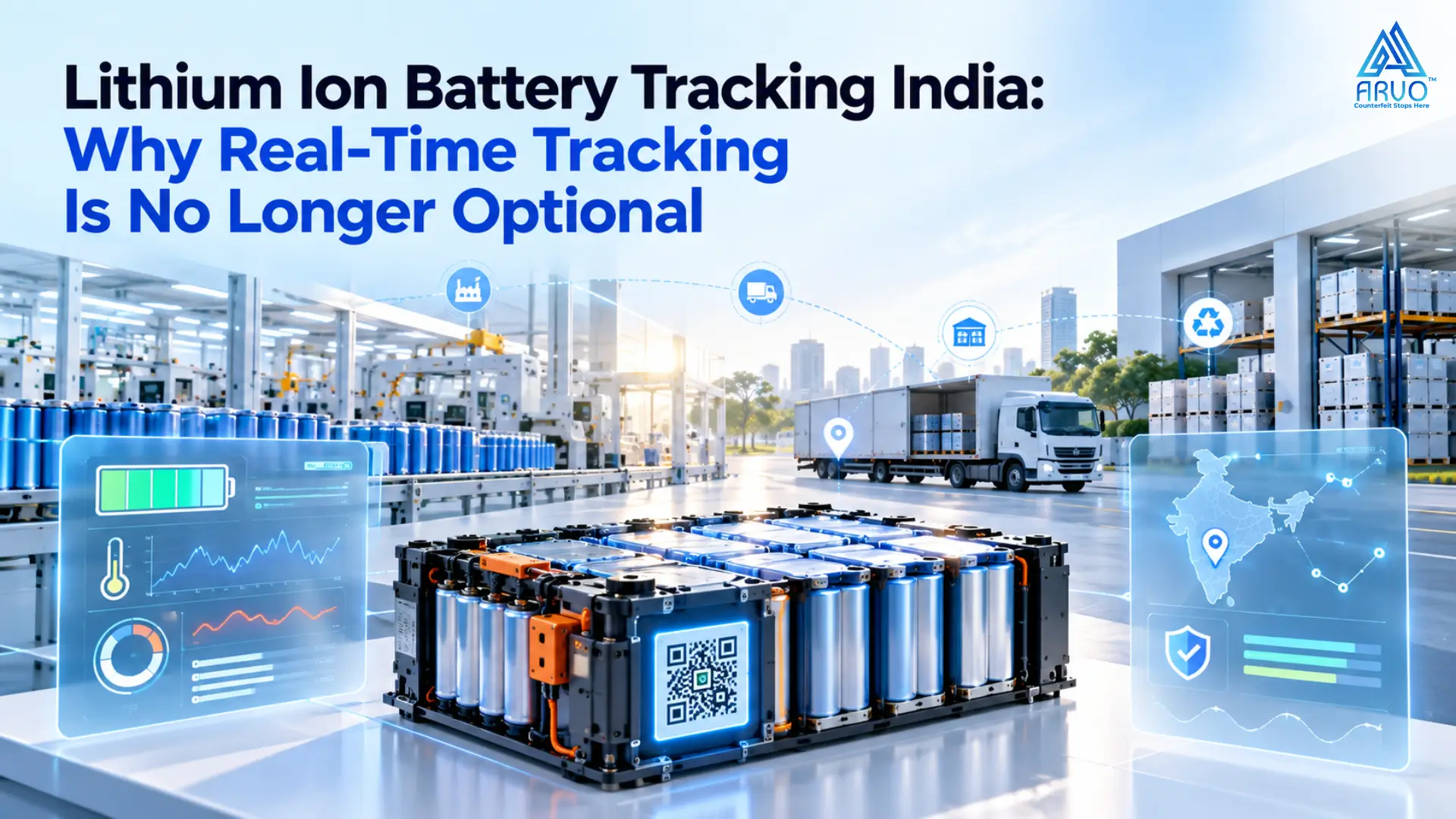
In 2025, India reported over 300 EV fire incidents.
Source: EVXpertz, Lithium Battery Fire Suppression Systems for Indian EV Facilities, August 2026
Three hundred fires. In homes where families were charging e-rickshaws overnight. In parking lots where electric scooters were plugged into standard outlets. In commercial garages where fleet vehicles were stored side by side. Each one of these incidents involved a lithium-ion battery that was manufactured, sold, and deployed without any mechanism for the manufacturer to know, in real time, whether that specific battery was developing the thermal conditions that lead to fire.
Now ask yourself this: when one of those 300 batteries caught fire, could the manufacturer trace it back to the exact production batch? Could they identify every other battery from that same batch and issue a targeted recall within hours? Could they prove, with documented evidence, that the battery was manufactured to specification, that it had not been subjected to conditions outside its design parameters, and that the manufacturer’s production process was not at fault?
In almost every case, the answer was no. Because lithium ion battery tracking India infrastructure did not exist at scale. The batteries were sold. The data trail ended at the point of sale. Everything that happened after, every charge cycle, every thermal excursion, every near-miss event, was invisible to the manufacturer. Until it became a headline.
India’s lithium-ion battery market is valued at $6.73 billion in 2026 and is growing at 17.65% CAGR toward $15.17 billion by 2031. The EV battery pack segment alone is growing at 42.47% CAGR. At this scale, with this growth trajectory, and with over 300 fire incidents in a single year, real-time battery tracking is no longer a technology discussion. It is a safety imperative, a regulatory requirement, and a business survival necessity.
Source: Mordor Intelligence, India Li-ion Battery Market 2026-2031; MarqStats, India EV Battery Pack Market 2026-2030
Table of Contents
The Safety Crisis: Why 300+ Fire Incidents Demand a Tracking Infrastructure
The 300+ EV fire incidents reported in India in 2025 are not random events. They follow predictable patterns that a battery tracking system India infrastructure would have detected before they became emergencies.
Thermal runaway, the cascading chain reaction that causes lithium-ion battery fires, does not happen without warning. In the hours and days before a catastrophic event, a battery exhibits measurable symptoms: elevated cell temperatures, abnormal voltage differentials between cells, accelerated capacity degradation, and irregular charge-discharge patterns. These symptoms are detectable. They are quantifiable. And with real-time monitoring infrastructure, they are preventable.
Source: Shankar IAS Parliament, Indore EV Tragedy: Why Do EV Batteries Catch Fire?, March 2026; RSC Advances, Mitigating Thermal Runaway in EV Batteries, July 2025
But detection requires data. And data requires tracking. Without a system that continuously monitors each battery’s operating conditions throughout its lifecycle, the warning signs are invisible. The manufacturer does not know that a battery is operating at elevated temperatures. The consumer does not know that their vehicle’s battery is approaching dangerous conditions. The first indication of a problem is the fire itself. By then, the data that could have prevented it is lost forever.
India’s Bureau of Indian Standards has published BIS 17802, a safety standard for secondary lithium cells and batteries used in EVs. The standard addresses manufacturing quality and testing protocols. But manufacturing quality alone does not prevent field failures caused by operational abuse: overcharging, extreme temperatures, physical damage, or use beyond the battery’s rated lifecycle. Battery safety India at scale requires real-time operational tracking, not just manufacturing compliance.
Source: BIS 17802: Safety Standard for Secondary Lithium Cells; RenewConnect, EV Battery Fires and Safety, January 2025
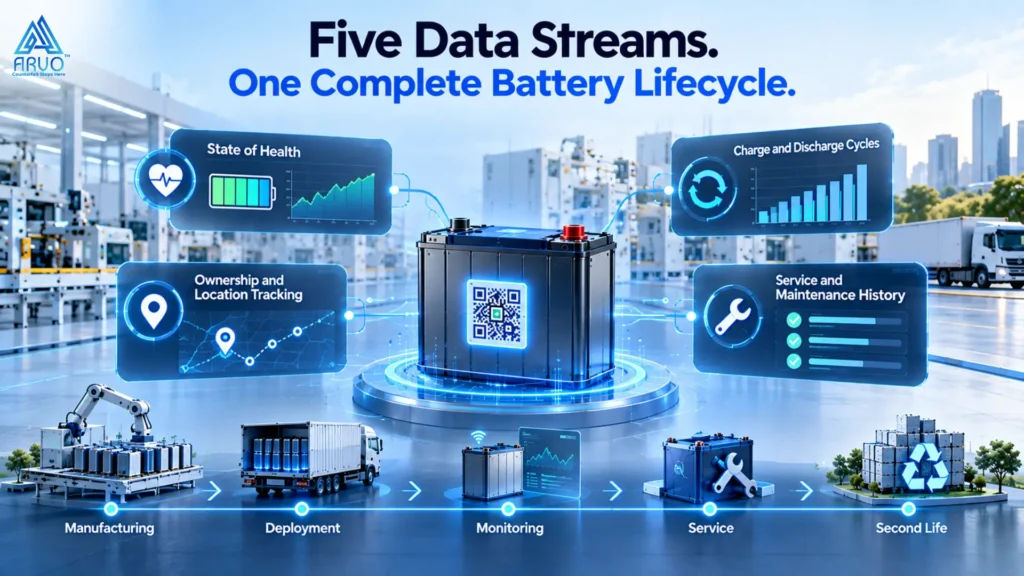
The 5 Data Streams That Every Battery Must Generate Throughout Its Entire Life
Effective real time battery monitoring is not a single measurement. It is a continuous flow of five interconnected data streams, each serving a different purpose, and each essential for safety, compliance, and commercial viability.
Data Stream 1: State of Health (SoH)
SoH measures the battery’s current capacity as a percentage of its original rated capacity. A battery at 95% SoH is nearly new. A battery at 75% SoH is approaching the end of its automotive life but may be viable for second-life applications. SoH is the single most important number in the battery’s lifecycle record. It determines remaining useful life, second-life suitability, and fair market value. Without continuous SoH tracking, every used battery transaction is a gamble. With it, every transaction is a data-backed decision.
Data Stream 2: Charge and Discharge Cycle Count
Every lithium-ion battery has a finite cycle life. A battery rated for 2,000 cycles at 80% depth of discharge will degrade predictably along a known curve. Tracking the actual cycle count against the rated cycle life provides a precise indicator of how much useful life remains. For manufacturers, this data is essential for warranty management. For second-life buyers, it is essential for asset valuation.
Data Stream 3: Thermal Event Logging
This is the data stream that saves lives. Every thermal excursion, whether a minor temperature elevation during summer charging or a significant thermal event approaching runaway conditions, must be logged with timestamp, duration, peak temperature, and resolution status. A battery with zero documented thermal events is a fundamentally different risk profile from a battery with three minor events, which is a fundamentally different proposition from a battery that experienced one major event.
Critically, thermal event data cannot be reconstructed after the fact. If the monitoring system was not capturing the data when the event occurred, the event is undocumented. For manufacturers facing safety investigations, undocumented thermal events are worse than documented ones, because the absence of data implies the absence of monitoring, which implies a failure of duty of care.
Data Stream 4: Ownership and Location Tracking
Who owns the battery? Where is it? Is it still in the vehicle it was originally installed in? Has it been transferred, sold, or repurposed? For lithium battery supply chain India traceability, ownership and location data is essential for EPR compliance under the Battery Waste Management Rules, 2022, for recall execution when safety issues are identified, and for grey market detection when batteries appear in unauthorised channels.
Data Stream 5: Service and Maintenance History
Every service intervention, whether a cell replacement, a BMS firmware update, a cell balancing adjustment, or a physical repair, must be recorded against the battery’s identity. Under the BPAN framework, a battery that has been materially altered requires a new BPAN. Service records determine whether an alteration is material. Without documented service history, the determination is subjective. With it, the determination is data-driven.
Source: MoRTH BPAN Guidelines, Tier 3 dynamic data specifications; CoEZET, IIT Madras, BPAN 6 data categories
Targeted Recall vs Blanket Recall: The Difference That Traceability Makes
When a safety incident occurs, the manufacturer’s response capability is determined entirely by their battery recall traceability infrastructure. The difference between having it and not having it is the difference between a contained, manageable response and a brand-destroying crisis.
| Recall Attribute | Without Tracking (Blanket Recall) | With Tracking (Targeted Recall) |
| Scope | Every battery from the affected model year or product line | Only batteries from the specific batch linked to the incident |
| Volume | Potentially thousands or tens of thousands of units | Precisely identified units from the affected serialisation range |
| Cost | Crores in logistics, replacement, and customer communication | Fraction of blanket recall cost |
| Speed | Weeks to identify scope, months to execute | Hours to identify scope, days to execute |
| Brand Impact | Headline: “Manufacturer recalls entire product line” | Headline: “Manufacturer identifies and resolves specific batch issue” |
| Regulatory Response | Regulator questions why scope is unclear | Regulator sees precise, data-backed response |
| Consumer Confidence | Eroded across all products | Maintained because response is precise and proactive |
In 2022, a major Indian EV manufacturer recalled over 1,400 vehicles after battery fire incidents. The recall covered the entire product line for a specific period because the manufacturer could not isolate the affected batteries to a specific batch or production run. With batch-level traceability, the recall could have been limited to the specific production batch linked to the defective cells, reducing scope, cost, and reputational damage by an order of magnitude.
Source: RenewConnect, EV Battery Fires and Safety, January 2025, nationwide recall data
SoH Monitoring: How Tracking Unlocks the ₹20,000 Crore Second-Life Economy
The Deccan Herald’s analysis of the BPAN framework identifies a transformative economic implication: with documented State of Health data, used EV batteries become precisely valued assets rather than unknown risks. This distinction is what enables the used EV market, second-life battery applications, and the entire circular economy that India’s battery strategy depends on.
Source: Deccan Herald, A Green Mobility Push Through Battery Aadhaar, SoH valuation analysis
Consider the economics. A new EV battery pack for a two-wheeler costs between ₹40,000 and ₹80,000 depending on capacity. When that battery reaches 75% to 80% SoH, it is no longer optimal for automotive use but retains significant capacity for stationary applications: solar energy storage, telecom tower backup, home energy storage, or UPS systems. Without SoH data, a buyer has no way to assess the remaining capacity, and the battery is valued at scrap material recovery value. With documented SoH data, the battery is valued at its actual remaining utility, which is significantly higher.
India’s EV fleet is growing at 42.47% CAGR. In the next five to eight years, millions of EV batteries will reach the end of their automotive life. The manufacturers who track SoH from Day 1 will have batteries with documented performance histories that command premium second-life prices. The manufacturers who do not will have batteries that can only be sold at scrap value. The difference, across millions of units, is measured in thousands of crores.
Source: MarqStats, India EV Battery Pack Market 2026-2030, 42.47% CAGR
What BPAN Mandates for Dynamic Data Tracking
The BPAN framework explicitly requires all five data streams described above. The PSA’s 49-page guideline specifies that the server-based dynamic data layer (Tier 3) must record State of Health measurements, charge and discharge cycle counts, thermal events and safety incidents, ownership transfer records, and maintenance and service history.
Source: PSA.gov.in Battery Pack Aadhaar Guideline, Tier 3 dynamic data specifications
This data must be maintained throughout the battery’s lifecycle and must be accessible to authorised stakeholders: manufacturers for recall management and warranty administration, vehicle OEMs for fleet management and consumer communication, regulators for safety investigation and compliance verification, service providers for maintenance decision-making, and recyclers for end-of-life processing. BPAN does not merely recommend tracking. It mandates it.
For manufacturers, the practical implication is clear. The BPAN framework is moving through AIS standardisation. When enforcement timelines are formalised, every battery manufacturer will need the infrastructure to capture, store, and report dynamic lifecycle data for every battery they produce. Building this infrastructure now, before the mandate carries enforcement penalties, provides both a compliance advantage and a safety advantage.
How ARVO Delivers Real-Time Battery Tracking in 7 Days
[Insert Image 5 here]
Alt Text: ARVO AIC dashboard with battery tracking system India showing thermal alerts and SoH data
ARVO’s platform provides the complete lithium ion battery tracking India infrastructure that manufacturers need to meet BPAN’s dynamic data requirements while simultaneously building the safety, recall, and second-life valuation capabilities that the market demands.
Copy-Proof Nova Codes: The Battery’s Permanent Digital Identity
Every battery receives a Nova code with CDP encryption that serves as its BPAN QR layer. The code is mathematically unique, physically unclonable, and permanently affixed. It is the anchor that connects every data stream to a specific, identifiable battery throughout its entire lifecycle. Authentication accuracy: 99.97%.
AIC Dashboard: Five Data Streams in One Command Centre
The AIC (ARVO Integrated Cloud) dashboard captures and displays all five critical data streams: SoH trends over time, charge cycle counts against rated cycle life, thermal event logs with timestamp and severity classification, ownership and location tracking with geographic scan data, and service history linked to each battery’s BPAN identity. Thermal alerts are delivered via email and SMS the moment a scan or data upload flags an anomalous reading. The manufacturer does not wait for a fire report. The alert arrives when the data indicates risk.
Recall Management: From Incident to Targeted Response in Hours
When a safety incident occurs, the AIC dashboard enables immediate batch identification through serialisation range lookup, instant enumeration of every other battery from the affected batch, geographic location data showing where those batteries are currently deployed, and communication triggers for targeted consumer notification. The recall is precise, fast, and documented.
Second-Life Valuation: SoH Data That Creates Asset Value
Every battery tracked through ARVO’s system accumulates a documented performance history. When the battery reaches end of automotive life, this history becomes its valuation document. SoH, cycle count, thermal event record, and service history together determine the battery’s second-life price. Buyers pay for documented certainty. ARVO provides that documentation.
15-Day Deployment
Day 1 to 4: Manufacturer onboarding and Nova code configuration. Day 5 to 7: Label design and production line integration. Day 7 to 14: First tracked production run with dynamic data capture. Day 15: AIC dashboard goes live with all five data streams, thermal alerts, and recall management tools. No production downtime. A few paise per unit.
Frequently Asked Questions
1. How many EV battery fire incidents occurred in India in 2025?
India reported over 300 EV fire incidents in 2025, involving two-wheelers, three-wheelers, and passenger vehicles. The incidents occurred during charging, storage, and post-accident scenarios. Most were attributed to thermal runaway caused by manufacturing defects, charging abuse, or environmental conditions exceeding the battery’s design parameters. The BIS 17802 safety standard addresses manufacturing quality, but real-time operational tracking is needed to prevent field failures caused by conditions after the battery leaves the factory.
Source: EVXpertz, August 2026; BIS 17802
2. What is the difference between a targeted recall and a blanket recall?
A blanket recall covers an entire product line or model year because the manufacturer cannot identify which specific batteries are affected. A targeted recall covers only the batteries from the specific production batch linked to the incident. Blanket recalls cost crores, take months, and damage the brand across all products. Targeted recalls cost a fraction, execute in days, and demonstrate precise, professional incident response. The difference is traceability: manufacturers with batch-level tracking can target. Those without it must blanket.
3. How does SoH tracking create commercial value for battery manufacturers?
A battery with documented SoH data, complete cycle history, and zero critical thermal events is a precisely valued second-life asset. It can be sold for stationary energy storage, telecom backup, or industrial applications at a price justified by data. A battery without lifecycle data is an unknown risk that buyers discount heavily or refuse entirely. As India’s EV fleet grows at 42.47% CAGR, millions of batteries will reach end of automotive life. Documented batteries command premium second-life prices. Undocumented batteries sell at scrap material value.
Source: Deccan Herald; MarqStats EV Battery Pack Market
4. What does BPAN require for dynamic data tracking?
BPAN’s Tier 3 server-based dynamic data layer mandates recording of State of Health, charge and discharge cycle counts, thermal events and safety incidents, ownership transfers, service and maintenance history, and recycling outcomes. This data must be maintained throughout the battery’s lifecycle and accessible to authorised stakeholders including manufacturers, OEMs, regulators, and recyclers. The data requirements are specified in the PSA’s 49-page guideline.
Source: PSA.gov.in BPAN Guideline; CoEZET, IIT Madras
5. How quickly can ARVO’s tracking system detect a thermal anomaly?
ARVO’s AIC dashboard processes data from scans and BMS data uploads in real time. When a thermal reading exceeds predefined thresholds, an alert is generated immediately and delivered via email and SMS to the manufacturer’s designated safety team. The system also flags batteries whose SoH degradation rate exceeds the expected curve, indicating potential internal issues before they manifest as thermal events. Detection speed depends on data upload frequency from the BMS, but with real-time integration, anomalies are flagged within the same operational cycle they occur.
300 Fires in One Year. The Question Is Not Whether to Track. It Is How Fast You Can Start.
Every untracked battery in your fleet is a battery whose thermal history is invisible, whose recall response will be imprecise, and whose second-life value will be guesswork. In a market reporting over 300 fire incidents annually and growing at 17.65% CAGR, that level of blindness is not just a compliance gap. It is a safety liability that compounds with every battery you ship without tracking infrastructure.
ARVO delivers complete lithium ion battery tracking: copy-proof Nova codes, five-stream real-time monitoring through the AIC dashboard, thermal alert systems, targeted recall capability, and SoH documentation for second-life valuation. Deployed in 7 days. A few paise per unit. 99.97% QR accuracy.
Start tracking every battery from Day 1. Schedule a consultation: