How many batteries did your factory produce last month?
You probably know the number. Most manufacturers track monthly production volumes. Now answer a harder question: for any one of those batteries, can you tell me where it is right now? Can you tell me its current state of health? Can you tell me whether it has experienced a thermal event? Can you tell me who owns it, what vehicle it is installed in, and whether it was ever serviced?
If you manufacture 10,000 battery packs a month and you cannot answer those questions for any individual unit, you do not have a production system. You have a black box. Products go in. Products come out. And after that, silence.
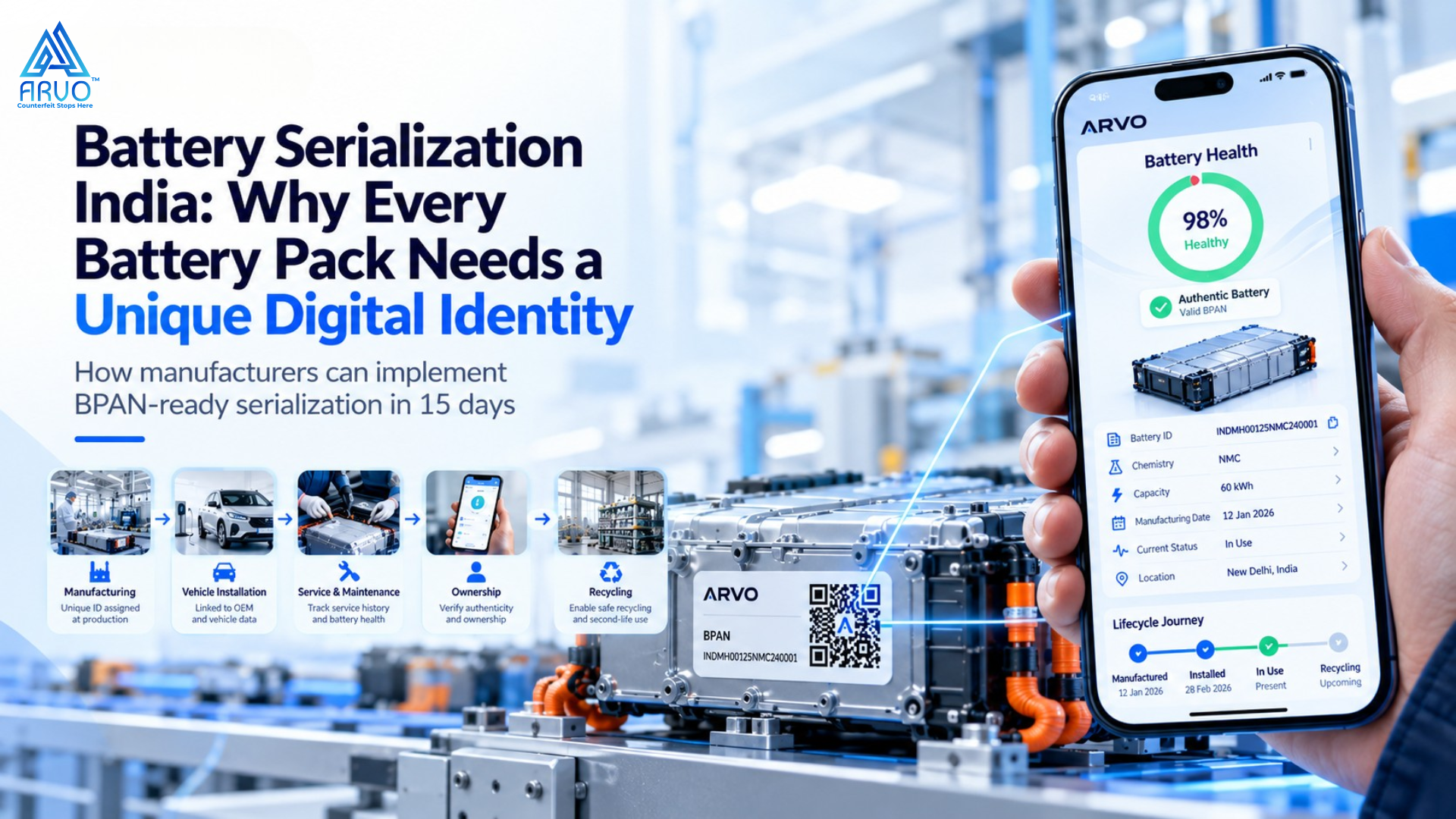
That silence is what the Battery Pack Aadhaar System (BPAN) is designed to eliminate. At its core, BPAN is India’s battery serialization India mandate. It requires every battery pack manufactured in or imported into India to carry a unique 21-character alphanumeric identity, permanently marked, digitally tracked, and maintained throughout the battery’s lifecycle, from the manufacturing floor to the recycling plant.
Source: MoRTH Draft Guidelines for Battery Pack Aadhaar System, January 2026
India’s lithium-ion battery market is valued at $6.73 billion in 2026 and is projected to reach $15.17 billion by 2031. Over 300 EV fire incidents were reported in 2025 alone. The PLI scheme has committed ₹18,100 Crore to domestic manufacturing. And yet, the vast majority of Indian battery manufacturers still operate without unit-level serialization. This article explains why that must change, what the consequences of inaction are, and how manufacturers can implement serialization within 15 days.
Source: Mordor Intelligence, India Li-ion Battery Market 2026-2031; EVXpertz, August 2026
Table of Contents
What Battery Serialization Actually Means (And What It Does Not)
Battery serialization is the process of assigning a unique, permanent, machine-readable identity to every individual battery pack at the point of manufacture. The operative word is individual. Not batch-level. Not model-level. Not SKU-level. Individual. Every single battery pack that leaves your production line carries its own identity that is distinct from every other battery ever manufactured, by any manufacturer, anywhere.
Under the BPAN framework, this identity is a 21-character alphanumeric code accompanied by a QR code and linked to a server-based data layer. But battery unique identification in India is not merely a labelling exercise. It is the foundation of everything that comes after: lifecycle tracking, safety monitoring, recall management, second-life valuation, EPR compliance, and PLI audit documentation. Without serialization, none of these capabilities exist. With it, all of them become possible.
Source: PSA.gov.in Battery Pack Aadhaar Guideline, 49-page document
Serialization is not a barcode on a carton. It is not a batch number in an ERP system. It is not a model identifier in a product catalogue. It is a unique, permanent, traceable digital identity assigned to a specific physical object and maintained from the moment of its creation to the moment of its recycling or disposal.
The BPAN Code: Decoding the 21 Characters That Define Every Battery
The BPAN code structure is a precisely engineered 21-character sequence. Every character has a purpose. Every section encodes specific information that enables identification, classification, and traceability.
Characters 1 to 5: The Battery Manufacturer Identifier (BMI)
The first two characters identify the region where the manufacturer is located. The next three characters identify the specific manufacturer. Together, these five characters form the battery manufacturer identifier, a code pre-assigned by the designated national organisation. The BMI is the digital fingerprint that permanently links every battery to its manufacturing origin. An inspector, regulator, recycler, or OEM who reads the first five characters of any BPAN instantly knows which manufacturer produced that battery and in which country.
Source: PSA.gov.in BPAN Guideline, Table 3: BMI Parameters; MoRTH Draft Guidelines
Characters 6 to 21: Specifications, Chemistry, and Serial Number
The remaining 16 characters encode the battery’s technical DNA: chemistry type (NMC, LFP, NCA, or other chemistries), nominal capacity, cell origin country, manufacturing date, and a unique serial number. SRM Technologies’ March 2026 analysis decoded a pilot BPAN example: a 30 kWh NMC battery with Korean-origin cells, manufactured on 17 April 2025, with a carbon footprint of 10 kgCO2e per kWh.
Source: SRM Technologies, BPAN: Backbone of India’s Evolving Battery Ecosystem, March 2026
The code must be physically marked on the battery pack in a clearly visible, accessible location, and must be resistant to damage, deterioration, and removal throughout the battery’s operational life. A new BPAN must be generated whenever a battery is recycled, repurposed, or materially altered, ensuring that the digital identity always reflects the battery’s current state. The previous BPAN is retained as a historical record, maintaining the complete lifecycle chain.
5 Things That Become Impossible Without Unit-Level Serialization
The consequences of operating without serialization are not abstract compliance risks. They are operational failures that cost crores, damage brands, and endanger lives.
1. Targeted Recalls Become Impossible
When a safety incident occurs with an unserialized battery, the manufacturer cannot identify which specific production batch is affected. The only option is a blanket recall covering the entire product line, model year, or chemistry type. In 2025, India reported over 300 EV fire incidents. Every recall triggered by these incidents was broader than it needed to be because manufacturers could not isolate affected units. A blanket recall costs 10x to 100x more than a targeted recall, takes months instead of days, and damages the brand across all products.
Source: EVXpertz, 300+ EV fire incidents in 2025; RenewConnect, nationwide recall data
2. Second-Life Valuation Becomes Guesswork
A battery’s second-life value depends entirely on its documented history: SoH, cycle count, thermal events, service records. Without serialization, there is no individual history. The battery is valued at scrap material recovery price, regardless of its actual remaining capacity. The Deccan Herald’s analysis estimates that documented batteries command significantly higher second-life prices than undocumented ones. Across millions of batteries reaching end of automotive life in the coming decade, the valuation gap is measured in thousands of crores.
Source: Deccan Herald, A Green Mobility Push Through Battery Aadhaar
3. PLI Audit Documentation Falls Apart
The PLI-ACC scheme requires manufacturers to prove domestic value addition at the individual production level. Without serialization, DVA claims are aggregate assertions supported by batch-level records that auditors cannot verify at the unit level. The IEEFA’s March 2026 assessment identified documentation challenges as a primary bottleneck in the 50 GWh vs 1.4 GWh execution gap. Serialization transforms DVA documentation from a manual compilation exercise into an automatic, audit-ready output.
Source: IEEFA, Assessing India’s ACC PLI Scheme, March 2026
4. EPR Compliance Cannot Be Verified at Scale
The Battery Waste Management Rules, 2022 require producers to document collection and recycling of batteries they introduced into the market. Without serialization, matching a recycled battery to the producer who originally sold it requires manual cross-referencing of sales records, distribution logs, and recycler intake registers. At the scale at which India’s battery market is growing, this manual process is operationally unsustainable. FY 2026-27 demands 90% material recovery for EV batteries. You cannot recover 90% of something you cannot individually identify.
Source: MoEFCC, Battery Waste Management Rules, 2022
5. Grey Market Diversion Goes Undetected
Without serialization, a manufacturer has no mechanism to verify whether a battery appearing in an unauthorised market was diverted from their authorised distribution or is a counterfeit. Serialized batteries carry traceable identities linked to specific distribution channels. When a battery surfaces in a market it was never assigned to, the diversion is immediately detectable. Without serialization, detection is impossible because the battery has no identity to trace.
Why Batch Tracking Is Not Serialization (And Why the Difference Matters)
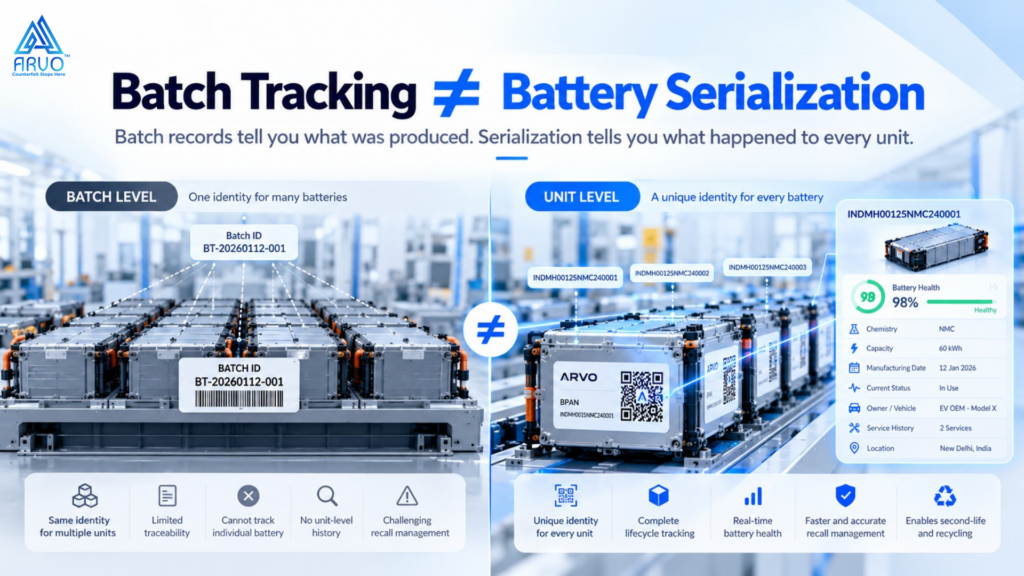
Many Indian battery manufacturers believe they already have traceability because they track production at the batch level. A batch record in the ERP system links a production run to a date, a raw material lot, and a quality certification. This is necessary. But it is not serialization.
| Capability | Batch Tracking | Unit-Level Serialization |
| Granularity | Identifies a production run (e.g., 500 or 1,000 units) | Identifies each individual battery pack |
| Recall Precision | Recalls entire batch (hundreds or thousands of units) | Recalls only the specific units linked to the issue |
| Lifecycle Tracking | Tracks batch from production. Loses visibility after dispatch. | Tracks individual battery from production through recycling |
| Second-Life Valuation | Cannot differentiate individual batteries within a batch | Each battery has documented SoH, cycle count, thermal history |
| EPR Attribution | Matches recycled volume to producer at aggregate level only | Matches each recycled battery to its producer and original sale |
| Grey Market Detection | Cannot identify which specific units were diverted | Flags specific units appearing in unauthorised locations |
| BPAN Compliance | Does not meet BPAN requirement for unit-level identity | Fully compliant with 21-character per-unit BPAN mandate |
| PLI DVA Verification | DVA proved at batch level. Auditors cannot verify individual units. | DVA traceable at individual battery level with full material chain |
The table makes the distinction clear. Batch tracking tells you what was produced. Serialization tells you what happened to every unit that was produced. The difference is the difference between compliance documentation and a battery pack numbering system that provides genuine lifecycle intelligence.
Source: Comparison based on MoRTH BPAN Guidelines requirements and PSA.gov.in BPAN Guideline specifications
The Regulatory Forces Converging on Serialization: Three Mandates, One Requirement
Indian battery manufacturers are not facing a single serialization mandate. They are facing three regulatory forces that all converge on the same requirement: every battery must have a unique, traceable battery digital identity.
Force 1: BPAN (MoRTH, January 2026)
The Battery Pack Aadhaar System explicitly mandates a 21-character unique identity on every battery pack. Phase 1 covers EV batteries. Phase 2 covers industrial batteries above 2 kWh. The framework is moving through AIS standardisation. Serialization is not an interpretation of the guideline. It is the literal requirement.
Source: MoRTH BPAN Draft Guidelines; The Policy Edge, January 12, 2026
Force 2: BWM Rules 2022 (MoEFCC, August 2022)
The Battery Waste Management Rules require producers to document collection and recycling against their sales volumes. While the Rules do not mandate unit-level serialization explicitly, meeting the 90% material recovery target and the domestically recycled content requirement at the scale at which India’s market is growing effectively requires it. You cannot reconcile what you cannot individually identify.
Source: MoEFCC, Battery Waste Management Rules, 2022
Force 3: EU Battery Regulation 2023
The EU Battery Regulation mandates digital passports with QR codes for EV and industrial batteries entering the EU market by 2027. Indian battery exporters who do not have unit-level serialization will be unable to generate the digital passport data required for EU market access. Serialization is not just a domestic compliance issue. It is a global market access requirement.
Source: EU Battery Regulation 2023 (2023/1542); The Policy Edge, global interoperability analysis
A Practical 15-Day Implementation Roadmap for Battery Manufacturers
Implementing battery serialization in India does not require a factory overhaul. It requires a systematic, phased approach that integrates serialization into existing production workflows without disrupting ongoing operations.
Days 1 to 3: Assess and Plan
Conduct a comprehensive assessment of your current production line, labelling infrastructure, and data systems. Identify the optimal physical location for BPAN marking on your battery pack formats. Map the data fields that need to be captured at the production stage against the BPAN three-tier requirements. Register for your Battery Manufacturer Identifier (BMI) with the designated national organisation.
Days 4 to 7: Configure and Design
Configure your serialization system: QR code generation, data encoding specifications, label design, and database architecture. Design labels that meet BPAN’s physical durability requirements for the harsh environments batteries operate in (heat, vibration, moisture, chemical exposure). Establish the data connections between your production system and the serialization platform.
Days 8 to 12: Integrate and Test
Integrate the serialization system with your existing production line. Run test batches to validate QR code print quality, scan reliability, data accuracy, and backend connectivity. Test label adhesion and durability on your specific battery pack materials. Validate that every unit receives a unique code and that the data flows correctly to the compliance platform.
Days 13 to 15: Pilot and Go Live
Run your first fully serialized production batch. Verify end-to-end: code generation, physical marking, QR encoding, data capture, and dashboard visibility. Resolve any issues identified during the pilot. By Day 15, every battery leaving your production line carries a unique, permanent, BPAN-compliant digital identity.
How ARVO Helps Manufacturers Achieve Serialization
ARVO provides end-to-end serialization infrastructure for battery manufacturers seeking BPAN compliance. The system covers unique code generation, copy-proof QR labelling, lifecycle data management, and a centralised dashboard for compliance reporting and operational intelligence.
ARVO’s solution integrates with existing production lines without requiring factory redesign or new capital equipment. The serialization system can be operational within 15 days of engagement, covering everything from BMI registration support through the first fully serialized production run.
The per-unit cost is a few paise. The system supports BPAN compliance, BWM EPR documentation, PLI audit readiness, and EU Battery Passport preparation through a single platform. Whether you manufacture EV battery packs, industrial batteries above 2 kWh, or both, ARVO’s serialization infrastructure scales to your production volume and product portfolio.
To learn how ARVO can make your manufacturing line BPAN-ready within 15 days, request a consultation with our team.
Frequently Asked Questions
1. Is battery serialization mandatory in India right now?
The BPAN framework, published by MoRTH in January 2026, requires a unique 21-character identity on every battery pack. The framework is being institutionalised through the AIS route under the AISC. While formal enforcement timelines have not yet been notified, the regulatory trajectory is clear. Additionally, the BWM Rules 2022 EPR compliance and the PLI-ACC scheme audit requirements both effectively necessitate unit-level tracking that only serialization provides. Manufacturers who implement serialization now will be positioned ahead of enforcement rather than scrambling to comply after it.
Source: MoRTH BPAN Guidelines; MoEFCC BWM Rules 2022
2. How is the 21-character BPAN code different from a serial number in our ERP system?
An ERP serial number is an internal reference. It may follow any format your organisation defines. The BPAN code is a standardised, nationally regulated 21-character sequence with a specific structure: the first 5 characters are the Battery Manufacturer Identifier (country + manufacturer), and the remaining 16 encode chemistry, capacity, cell origin, manufacturing date, and a unique serial. The BPAN code is physically marked on the battery, accompanied by a QR code, and linked to a national data system. It is designed for external interoperability across manufacturers, OEMs, regulators, and recyclers.
Source: PSA.gov.in BPAN Guideline, Table 3
3. What happens when a battery is recycled or repurposed? Does it keep the same BPAN?
No. The BPAN guideline specifies that a new BPAN must be generated whenever a battery is recycled, repurposed, or materially altered. This ensures the digital identity always reflects the battery’s current composition and condition. The previous BPAN is retained as a historical record, maintaining the complete lifecycle trail. The requirement for a new BPAN on material change is what makes serialization a lifecycle system, not a one-time labelling event.
Source: MoRTH BPAN Guidelines; PSA.gov.in Guideline
4. Can I use a standard QR code for BPAN serialization, or does it need to be copy-proof?
The BPAN guideline mandates a QR code on every battery encoding static technical data. While the guideline does not explicitly specify copy-proof technology, the entire purpose of the BPAN system- tamper-proof lifecycle traceability- is undermined if the QR can be photographed and duplicated. A standard QR code can be cloned in seconds. For a system designed to provide reliable digital identity for safety, recall, and compliance purposes, copy-proof QR technology is the only approach that preserves the integrity of the serialization framework.
5. How long does it take to implement serialization on an existing battery production line?
With a structured approach, a battery manufacturer can move from zero serialization to fully operational BPAN-compliant production within 15 days. Days 1 to 3 cover assessment and planning. Days 4 to 7 cover system configuration and label design. Days 8 to 12 cover production line integration and testing. Days 13 to 15 cover the pilot run and go-live. No production downtime or factory redesign is required. The serialization layer integrates with existing infrastructure.
Every Battery Without a Digital Identity Is a Liability. Every Battery With One Is an Asset.
India’s battery market is growing at 17.65% CAGR toward $15.17 billion by 2031. BPAN is moving through standardisation. BWM Rules demand EPR reconciliation at scale. PLI audits require unit-level provenance documentation. The EU Battery Passport requires digital identity for export. And over 300 fire incidents in 2025 demonstrated what happens when batteries cannot be individually traced.
The manufacturers who serialise now will have recall precision, second-life revenue, regulatory compliance, and operational intelligence. The manufacturers who wait will have batch records that cannot answer the questions regulators, recyclers, OEMs, and consumers are already asking.
Make every battery identifiable. Start with ARVO: