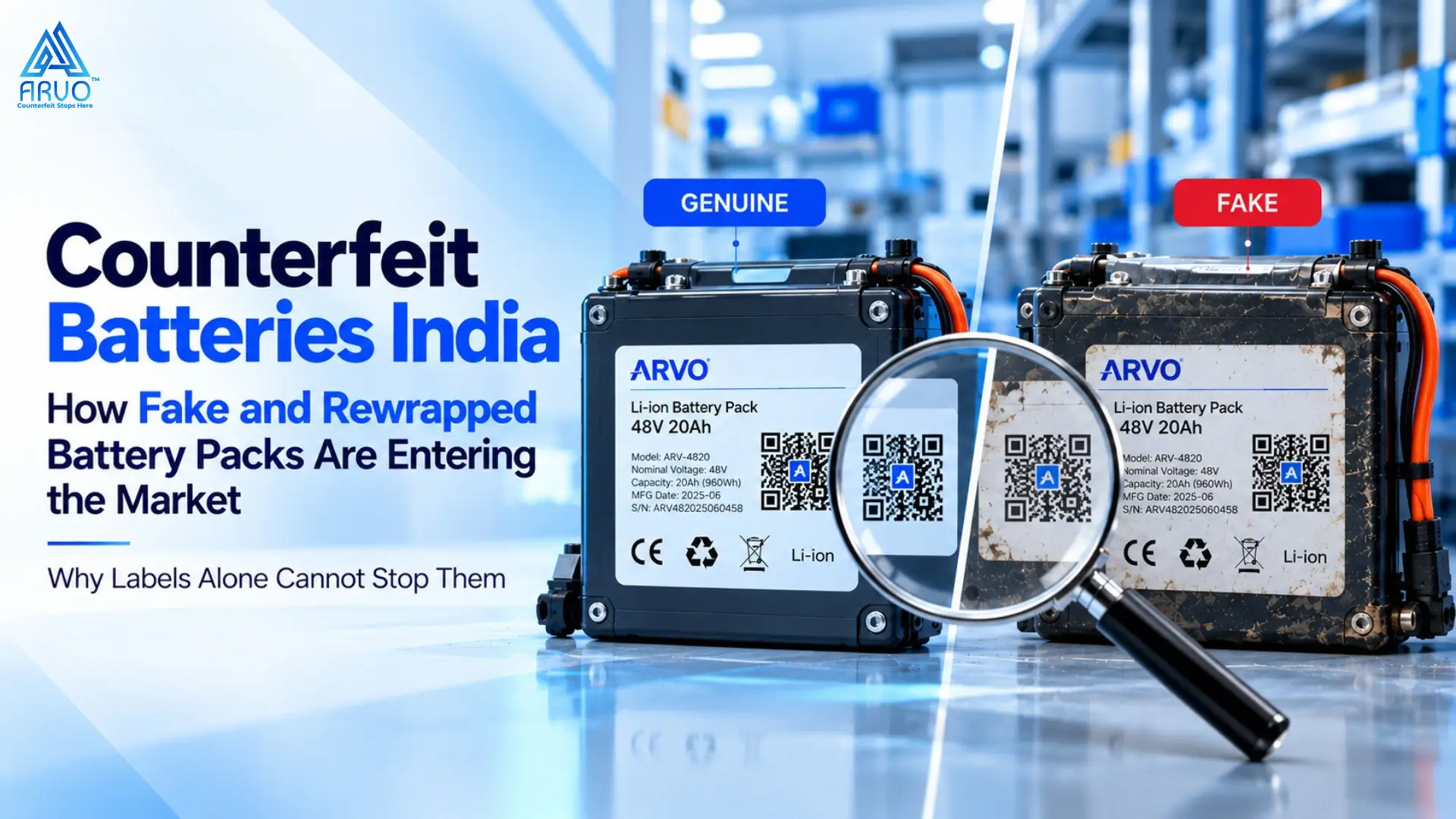
The label is the cheapest part of a battery to copy. It costs a counterfeiter almost nothing to reproduce your logo, your capacity rating and your certification marks. What it costs your brand is a very different number. The counterfeit batteries India manufacturers are fighting today include fake lithium battery packs sold under trusted names, old cells rewrapped as new, and products carrying certification marks they never earned.
The scale is no longer small. India’s illicit market across five key industries is valued at ₹7.97 Lakh Crore, according to FICCI CASCADE. The latest ASPA and CRISIL survey found that 89% of urban consumers have bought a counterfeit product at least once, and that 53% of counterfeit purchases now happen on online aggregator platforms. Batteries sit right in the path of this trade: high value, high demand and almost impossible for a buyer to inspect. That combination is why counterfeit batteries India-wide have become one of the fastest-growing threats to genuine manufacturers.
This guide is written for brand protection heads, CEOs and sales leaders at EV, inverter and consumer battery companies. It explains how counterfeit batteries India buyers receive actually enter the market, why visual checks and printed labels fail, what the problem costs genuine makers, and what a workable defence looks like.
Counterfeit Batteries India: The Problem in Numbers
Before looking at how fakes get in, it helps to see the market they feed on. India’s lithium-ion battery market is estimated at $6.73 billion in 2026 and is forecast to reach $15.17 billion by 2031, growing at 17.65% a year. Every rupee of that growth is also an opportunity for counterfeiters, which is why counterfeit batteries India-wide are now a board-level issue rather than a sales-team complaint.
| Indicator | Figure | Source |
| Total illicit market across 5 key industries in India | ₹7.97 Lakh Crore | FICCI CASCADE / TARI, 2024 |
| Urban consumers who have bought a counterfeit at least once | 89% | ASPA / CRISIL, 2025 |
| Indians who encountered a fake product in the past 12 months | About 35% | ASPA / CRISIL, 2025 |
| Share of counterfeit purchases made on online aggregator platforms | 53% | ASPA / CRISIL, 2025 |
| Consumers who met fake automotive parts in the past year | About 22% | ASPA / CRISIL, 2025 |
| Consumers who met fake consumer durables, including electronics, in the past year | About 18% | ASPA / CRISIL, 2025 |
| Premium consumers say they would pay for guaranteed genuine products | 9% | ASPA / CRISIL, 2025 |
| India lithium-ion battery market, 2026 | $6.73 billion | Mordor Intelligence, 2026 |
| Forecast India lithium-ion battery market, 2031 | $15.17 billion | Mordor Intelligence, 2026 |
Two numbers matter most for battery brands tracking counterfeit batteries India-wide. First, 53% of fakes are bought online, where the buyer never touches the product before paying. Second, consumers say they would pay a 9% premium for products guaranteed to be genuine. The demand for proof already exists. Most battery brands simply do not offer it yet.
Sources: FICCI CASCADE and TARI, “Consuming the Illicit” (September 2024); ASPA and CRISIL, “State of Counterfeiting in India 2025” (released March 2026); Mordor Intelligence, India Lithium-ion Battery Market 2026 to 2031.
What Counts as a Counterfeit Battery?
“Counterfeit” covers far more than a crude copy. Among the counterfeit batteries India brands and investigators deal with, there are five common types, and the most dangerous ones look the most genuine.
1. Rewrapped Battery Cells
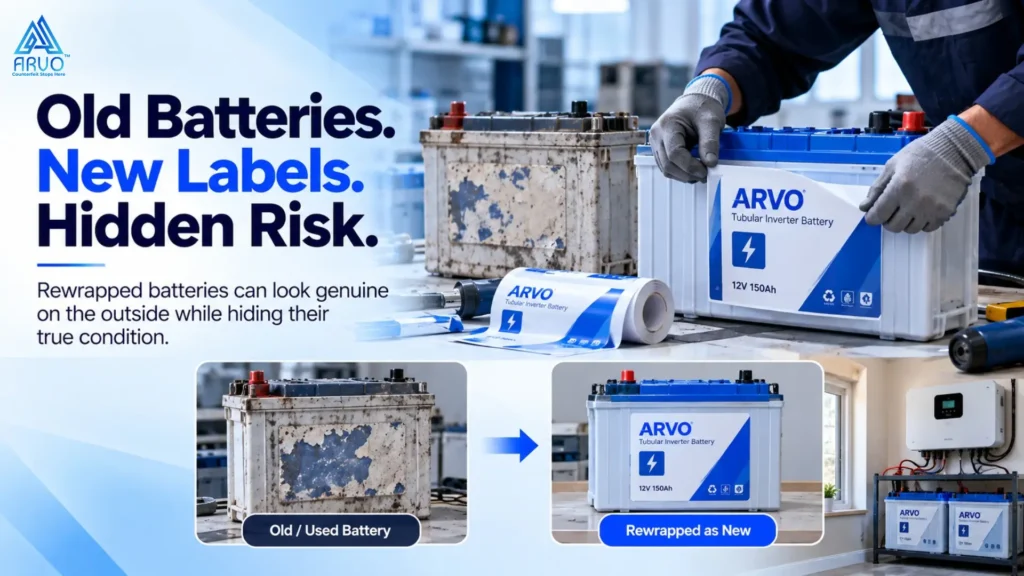
This is the most common form of counterfeit batteries India repair markets see. Old, scrap or rejected cells are stripped and given a fresh sleeve printed with a known brand’s design. Rewrapped battery cells look new on the outside but may have hundreds of charge cycles behind them, or may have failed quality checks at the factory that made them. Researchers who audit battery factories describe relabelled scrap cells as one of the most common routes to market.
2. Relabelled Packs With Overstated Capacity
Genuine but lower-grade cells are labelled with a higher capacity than they can deliver. The buyer gets a battery that works but runs out early, fails sooner, and gets blamed on the brand printed on it. Overstated capacity is one of the hardest kinds of counterfeit batteries India buyers can spot, and it is now firmly on the regulator’s radar: BIS guidelines issued in April 2026 require rated capacity to be verified for licensed lithium cells and batteries, with a deadline of 30 April 2027.
3. Homemade Cells Without Safety Engineering
A basic lithium-ion cell is not hard to assemble. What is hard is the safety engineering inside it. Small workshops supplying counterfeit batteries India-wide can make cells that work on day one but lack the insulators, safety tape, and protective devices that stop a fault from turning into a fire.
4. Cloned Brand Packs
Complete packs are built to look exactly like a known brand’s product, down to the casing, the labels, and serial numbers and QR codes copied from a genuine unit. These target the replacement market, where a buyer asks for a brand by name and accepts whatever carries that name. Cloned packs are the type of counterfeit batteries India brand owners find hardest to explain to their own customers.
5. Products Carrying Fake Certification Marks
Some products carry certification marks they never earned. In one 2025 raid on an e-commerce warehouse in Delhi, the Bureau of Indian Standards seized more than 3,500 products worth about ₹70 lakh that either lacked the mandatory ISI mark or carried counterfeit ISI labels. That case involved appliances rather than batteries, but it shows how easily the marks buyers trust can be printed by anyone.
Sources: IEEE Spectrum, “How to Spot a Counterfeit Lithium-Ion Battery” (November 2025); BIS guidelines on capacity verification of lithium cells and batteries (April 2026); DD News, “BIS cracks down on e-commerce giants for selling substandard products” (April 2025).
5 Ways Counterfeit Batteries India Buyers Receive Enter the Market
Knowing the routes in is the first step in battery brand protection. These five channels carry most of the counterfeit batteries India buyers end up with, and each one has a different weak point.
1. Online Aggregator Platforms
More than half of all counterfeit purchases in India now happen on online aggregators, according to ASPA and CRISIL. For counterfeit batteries India buyers order online; this is the riskiest channel of all. The buyer sees a photo, a price, and a star rating. They cannot check the weight, the build quality, or the cell inside. Third-party sellers can list fakes alongside genuine stock, and by the time a complaint reaches the brand, the seller has often moved on to a new listing.
2. Social Media Ads and Direct Sellers
The same survey flags social media advertising as an emerging channel for counterfeit consumer electronics. Ads promise branded batteries at prices no authorised dealer can match, often with cash on delivery and no proper invoice. The brand never sees these sales and only hears about them when a failed product comes back through its service network.
3. Unauthorised Distributors and Grey Market Stock
Batteries pass through several hands between factory and buyer: distributors, sub-distributors, wholesalers and retailers. Every handover is a point where counterfeit batteries India distributors cannot trace can be mixed with genuine stock. When a wholesaler blends 50 genuine packs with 50 fakes in the same consignment, neither the retailer nor the buyer can tell the difference.
4. Replacement and Repair Markets
Inverter, e-rickshaw, two-wheeler, and laptop owners usually replace batteries through local repair shops. The buyer asks for a brand, and the shop fits whatever carries the right label. This is where cloned packs, rewrapped battery cells, and other counterfeit batteries India buyers never question do most of their business this way, because the buyer rarely sees the original box and seldom verifies the product.
5. Unverified Cells Inside Genuine-Looking Packs
Not every counterfeit reaches the market as a finished fake. Pack assemblers that buy cells from unverified sources can end up building counterfeit cells into packs that carry their own genuine brand. Researchers studying counterfeit lithium-ion batteries found that packs sold under the same brand can have different internal structures, which is exactly what happens when cell sourcing is not tracked unit by unit.
Sources: ASPA and CRISIL, “State of Counterfeiting in India 2025” (via The Week, 16 March 2026); Kong, Das and Pecht, “The Distribution and Detection Issues of Counterfeit Lithium-Ion Batteries,” Energies (MDPI), 2022.
Why a Fake Lithium Battery Is a Safety Risk, Not Just a Sales Loss
A fake shampoo disappoints. A fake lithium battery can catch fire. That difference is why counterfeit batteries India manufacturers face must be treated as a safety issue first and a revenue issue second.
A 2023 study led by UL Research Institutes compared genuine and counterfeit cells. The fakes had thinner insulators or none at all, little or no safety tape around the core, and were missing the internal protections that cut current during overcharging or a short circuit. These are precisely the features that stop thermal runaway, the chain reaction behind most battery fires. Researchers who audit battery factories estimate that counterfeit cells carry risks an order of magnitude worse than certified ones. Every one of the counterfeit batteries India buyers install is a fire risk that the genuine brand cannot see.
Battery systems that cannot be verified can also be tampered with. In July 2026, the Ministry of Electronics and Information Technology had battery management apps removed from app stores after videos showed people using them over Bluetooth to cut power to moving e-rickshaws. The episode was not about counterfeits directly, but it exposed the same weakness: once a battery pack leaves the factory, most of the market has no way to check what is inside it or who controls it.
For a battery brand, every fire involving a product with its name on the label becomes its problem, whether or not it made that battery. Without unit-level proof of what it shipped, a brand cannot prove what it did not ship.
Sources: IEEE Spectrum (November 2025), citing a 2023 UL Research Institutes study; Business Today, “Apps enabling pranksters to stop vehicles remotely deleted, says MeitY” (3 July 2026).
Why Labels Alone Cannot Stop Counterfeit Batteries India Brands Face
Most battery brands rely on some mix of printed labels, holograms, serial numbers, and QR codes. Each of these was designed to inform the buyer, not to resist a determined counterfeiter, and none of them has slowed the spread of counterfeit batteries India-wide.
The research on counterfeit batteries India and other markets face is direct on this point. The Energies study found that simple external visual inspection of a battery is unreliable. The UL-led study found that counterfeit labels closely matched the originals. If trained engineers struggle to tell a fake from its label, a buyer standing in a repair shop has no chance.
| Method | How It Is Meant to Work | Why It Fails |
| Printed brand label | Shows brand, model, and capacity | Copied with ordinary printing; rewrapped cells simply get new labels |
| Hologram sticker | Hard-to-copy visual mark | Similar holograms are easy to source; used stickers can be peeled and reused |
| Sequential serial number | One number per unit | Numbers follow a pattern and can be guessed or copied from a genuine unit |
| Standard QR code | Links to product information | Can be photographed and reprinted; every clone scans as genuine |
| Certification marks | Shows the product passed testing | Marks can be printed on products that were never tested |
| App-based verification | Buyer downloads an app to check | Most buyers will not install an app at the counter, so few products are ever checked |
The common flaw is that every one of these methods can be copied exactly. A standard QR code printed on a fake pack scans the same way as the genuine one. A hologram bought from the same type of supplier looks identical. The more visible a security feature is, the more easily a counterfeiter can study it and reproduce it.
Duplicate battery detection only works when the identity on each unit cannot be reproduced and can be checked by anyone in seconds, without special tools or a dedicated app. We explain this in more detail in our guide to copy-proof battery QR codes under BPAN.
What Counterfeit Batteries India Makers Face Really Cost
The revenue lost to counterfeit batteries India manufacturers compete with is only the visible part of the damage. For battery makers, the hidden costs are often larger.
- Warranty claims on products you never made. Fakes fail early. Buyers return them to your dealers, and without proof of origin, your service team has to honour or dispute every claim.
- Brand damage that spreads. A buyer whose battery failed or overheated blames the name on the label. Online reviews and dealer word of mouth do not separate fakes from genuine units.
- Lost dealer trust. Authorised dealers undercut by cheaper fake stock lose margin, and over time they lose interest in pushing your brand.
- Wider recalls. When something goes wrong, a brand that cannot separate genuine units from fakes must recall broadly instead of precisely.
- Regulatory exposure. India’s draft Battery Pack Aadhaar framework requires a unique identity and QR code on every EV and industrial battery pack, and BIS now requires verified capacity for licensed lithium products. Brands without unit-level records will find both harder to meet.
On the other side of the ledger is the 9% premium consumers say they would pay for guaranteed genuine products. For a brand that can prove authenticity at the point of sale, an original battery check becomes a reason to buy, not just a line of defence.
Duplicate Battery Detection: What a Workable System Needs
If labels cannot do the job, what can? Any system that aims to stop counterfeit batteries India-wide has to pass five tests.
- Unique identity per unit. Every pack needs its own identity, not a batch number shared by thousands of units.
- Impossible to copy. The identity must stay unique even if someone photographs or reprints it.
- Easy for anyone to check. A buyer, dealer or service technician should be able to run an original battery check with the phone camera they already use, with no app to download.
- Data back to the brand. Every check should tell the manufacturer where and when its product was scanned, so it can spot fakes and diverted stock early.
- Fits existing production. It should work with the printers and lines the factory already runs, without slowing output.
Few traditional methods pass more than one of these tests, which is why counterfeit batteries India buyers receive keep slipping through. That gap is why battery brand protection in India is moving away from visual security features and towards digital, unit-level authentication.
How ARVO Helps Battery Brands Stop Counterfeit Batteries
ARVO is dedicated to preventing counterfeiting for Indian manufacturers. For battery makers dealing with counterfeit batteries India-wide, ARVO provides Nova codes: copy-proof QR codes that give every battery pack a unique identity that cannot be cloned.
Anyone can verify a pack with any QR scanner, with no app and no registration. Nova codes print on your existing printers, so no extra hardware is needed. Every scan gives your team real-time visibility of where and when your products are checked, and the AIC dashboard brings that data together to flag fakes and grey market stock. The same codes also help you get ready for Battery Pack Aadhaar requirements.
Deployment takes 15 days and costs only paise per unit, a small price against crores in protected revenue. To see how it works for your product line, talk to the ARVO team.
Frequently Asked Questions
What types of counterfeit batteries India buyers face are most common?
The most common counterfeit batteries India buyers face are rewrapped battery cells sold as new, packs labelled with more capacity than they deliver, homemade cells without proper safety engineering, cloned brand packs, and products with fake certification marks. Researchers say small cylindrical cells used in low-cost devices are among the most frequently faked, and in India the inverter and vehicle replacement markets are especially exposed.
How can I do an original battery check on a lithium battery?
Visual inspection is not reliable, because the labels on counterfeit batteries India buyers see closely match genuine ones. Buy from authorised dealers, insist on a proper invoice and warranty card, and check whether the brand offers a scan-to-verify code. A copy-proof code that you can scan with your phone camera is the most reliable check available to buyers today.
Why can’t holograms and standard QR codes stop fake batteries?
Both can be copied exactly, which is why they have not slowed counterfeit batteries India-wide. Similar holograms are easy to source, and a standard QR code can be photographed and reprinted so that the clone scans just like the original. Protection only works when each unit carries an identity that cannot be reproduced.
How do counterfeit batteries hurt manufacturers that never made them?
Counterfeit batteries India buyers purchase fail early and are returned through the genuine brand’s dealers, which drives warranty disputes, negative reviews and lost dealer trust. In a safety incident, the brand on the label takes the blame and may face a broader recall than necessary if it cannot separate its own units from fakes.
How does ARVO help with duplicate battery detection?
ARVO gives every battery pack a copy-proof Nova code that anyone can verify with a normal QR scanner. Each scan sends location and time data to the AIC dashboard, so brands can spot fakes and diverted stock. It works with existing printers and goes live in 15 days.
The Bottom Line for Battery Brands
The market for counterfeit batteries India manufacturers compete with will grow as fast as the battery market itself. Every label, hologram and printed code a brand uses today can be copied, and counterfeit batteries India buyers cannot tell apart will keep carrying those copies. What cannot be copied is a unique, verifiable identity on every unit, checked by buyers and reported back to the brand in real time. Brands that put that proof on their packs now will protect their customers, their dealers and their name. Start protecting your battery brand with ARVO.